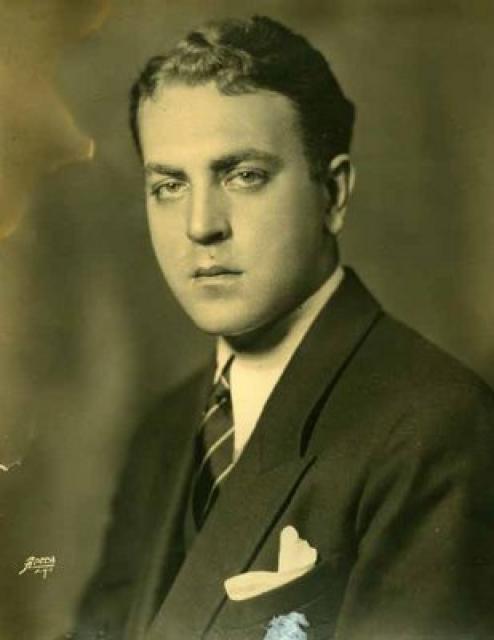
Val Lewton
 USA
USA- Val Lewton: A Literary and Cinematic Master
- Early Writing and Journalism
- Novels and the Bestseller "Not So Quiet"
- Hollywood Career with MGM and David O. Selznick (1932-1941)
- Script Editor and "Gone with the Wind"
- RKO Pictures: King of Low-Budget Horror (1942-1946)
- Low-Budget Horror Formula
- Features of Lewton's Horror Films
- Minimal Graphic Violence
- Lewton's RKO Films
- "I Walked with a Zombie" (1943)
- "Leopard Man" (1943)
- Collaborations with Robert Wise and Mark Robson
- Wise's Films
- Robson's Films
- "Mademoiselle Fifi" (1944)
- "The Body Snatcher" (1945)
Val Lewton: A Literary and Cinematic Master
Early Life and Literary CareerBorn in the Russian Empire (1904)
Val Lewton, born Vladimir Ivanovich Leventov in Yalta, Crimea, was the son of a failed pawnbroker and a pharmacist's daughter. His family immigrated to New York City in 1909, where he lived with his aunt, actress Alla Nazimova.
Early Writing and Journalism
At 16, Lewton was "fired from a job as a reporter for the Darien-Stamford Review after it was discovered that an article he had written about a shipment of kosher chickens dying in the New York heat was a hoax." He later changed his name and attended Columbia University before becoming a journalist. Lewton wrote for newspapers and magazines, often using pseudonyms to obscure his authorship.
Novels and the Bestseller "Not So Quiet"
Before his filmmaking career, Lewton "became an established writer, penning 10 novels in all, six nonfiction books, a book of poetry, and even a pornographic novel, 'Jasmine' (or 'Grushenskaya')." In 1932, his novel "Not So Quiet" became a bestseller, telling the story of an unemployed young woman navigating the Great Depression in New York City.
Hollywood Career with MGM and David O. Selznick (1932-1941)
Connection to Hollywood through NazimovaLewton's aunt, Alla Nazimova, helped him enter the film industry by securing him a job in the story department of MGM.
Script Editor and "Gone with the Wind"
Lewton worked as a script editor and general assistant to producer David O. Selznick. He was credited with staging the famous crane shot from "Gone with the Wind" (1939), where Scarlett walks through endless rows of dead and injured Confederate soldiers.
RKO Pictures: King of Low-Budget Horror (1942-1946)
Joining RKOIn 1942, Lewton joined RKO Pictures, a struggling studio in the wake of financial failures like Orson Welles's "Citizen Kane" and "The Magnificent Ambersons."
Low-Budget Horror Formula
Lewton was hired to produce a series of low-budget horror films, and his work during this period became legendary. He was given strict parameters: budgets of $150,000, running times under 75 minutes, and studio-assigned titles.
Features of Lewton's Horror Films
Psychological and Unseen HorrorLewton specialized in "low-budget but highly effective spook shows, co-writing the scripts for many of them." He often suggested his own stories and "hired writers to provide the first draft, but rewrote the final shooting scripts himself." He "never credited himself on screen for these rewrites, except when he used the pseudonym Carlos Keith for 'The Body Snatcher' and the film noir 'Bedlam.'"
Minimal Graphic Violence
Lewton "devised a school of suggestive filmmaking under the credo 'less is more,' where shock value was replaced by shadows and sounds, and the unseen often frightened more than the seen."
Lewton's RKO Films
"Cat People" (1942)Lewton's first and arguably greatest horror film, "Cat People" follows a young woman in New York who descends into madness and transforms into a panther.
"I Walked with a Zombie" (1943)
A nurse travels to the Caribbean to care for the wife of a plantation owner, encountering a mysterious condition that may be psychological illness, witchcraft, or zombification.
"Leopard Man" (1943)
A panther escapes from a cage in a small New Mexico town, leading to grisly murders. However, the path to uncovering the killer is not straightforward.
Collaborations with Robert Wise and Mark Robson
Emergence of Wise and RobsonAs Jacques Tourneur moved on to bigger-budget films, Lewton began directing his movies with rising RKO filmmakers Robert Wise and Mark Robson.
Wise's Films
Wise directed three films for Lewton, including "Curse of the Cat People" (1944), a fantasy told from the perspective of a child.
Robson's Films
Robson directed four films for Lewton, including "The Seventh Victim" (1943), a chilling tale of Satanism, and "The Ghost Ship" (1943), a psychological horror about a ship's haunted crew.
"Mademoiselle Fifi" (1944)
In an attempt to expand beyond horror, Lewton produced "Mademoiselle Fifi," a historical drama set during the Franco-Prussian War. However, the film was poorly received.
"The Body Snatcher" (1945)
Lewton's only official screenwriting credit is for "The Body Snatcher," a collaboration with Robert Wise. It tells the story of a medical scientist who hires a cabman to illegally procure fresh corpses for experiments.


