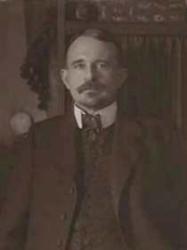
Valentin Kiparsky
 Finland
- Early Life and Education
- Academic Journey and Slavic Studies
- Scientific Career: Loanwords and Baltic Studies
- Academic Appointments and Honors
- Personal Life and Legacy
Early Life and Education
Valentin Kiparsky was born into a Russian-German aristocratic family in St. Petersburg on August 29, 1904. As a child, he resided on the family's farm in Perkjärvi, Karelian Isthmus. By this time, Kiparsky was fluent in German (native tongue), Russian (second native tongue), French (tutored from age five), Latin, and Greek. He further mastered Finnish and Swedish for his secondary school examinations. Ultimately, Kiparsky commanded fourteen languages actively and more passively. His most notable works were published in German, as was customary, with some translated into English.
Academic Journey and Slavic Studies
At the University of Helsinki, Kiparsky immersed himself in linguistics. Initially drawn to Germanic and Romance languages, he was inspired to pursue Slavic studies by Professor Josef Julius Mikkola. His 1929 doctoral thesis still focused on Germanics, but he concurrently studied Slavic philology, Sanskrit, and Latin. Two research trips to Czechoslovakia exposed Kiparsky to phonology, a new field pioneered by the Prague Linguistic Circle, and he wrote a significant article on 19th-century Czech neologisms.
Scientific Career: Loanwords and Baltic Studies
Kiparsky commenced his academic career investigating loanwords. His dissertation submitted to the University of Königsberg in 1934 examined Proto-Slavic loanwords in Germanic languages and became a definitive reference in the field.
Kiparsky's subsequent scientific expedition to Latvia and other Baltic countries, funded by a grant, equipped him with Latvian and Estonian language proficiency. He delved into the history of Baltic languages and regions. The expedition laid the groundwork for two extensive studies: on the origins of the ancient Curonians and on loanwords in Baltic German, a dialect spoken by 100,000 in the Baltics at the time but extinct after World War II. This study required an intricate understanding of Slavic, Baltic, and Finnic languages.
Academic Appointments and Honors
Upon returning to Finland in 1938, Kiparsky was appointed Associate Professor of Slavic-Baltic Linguistics at the University of Helsinki. After World War II, he became Head of the newly established Professorship of Russian Language and Literature in 1947. He served as a visiting professor in the UK (Birmingham) and the US (Indiana) from 1952 to 1955. In 1958, he secured a permanent position as Professor of Slavic Philology at the Free University of Berlin. Kiparsky returned to Finland in 1963 to take up a professorship in Slavic Philology. He retired in 1974.
Kiparsky's reputation extended internationally. He published 11 monographs and over 400 scholarly publications. Among his accolades was the honorary Doctor of Letters (1977) from both the University of Poznań and the University of Stockholm.
Personal Life and Legacy
Valentin Kiparsky's son, Paul Kiparsky, born in 1941 to his second wife Dagmar (née Jaatinen), studied at MIT and is a current Professor of Linguistics at Stanford University.