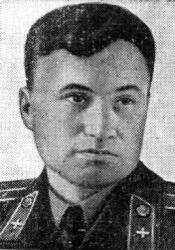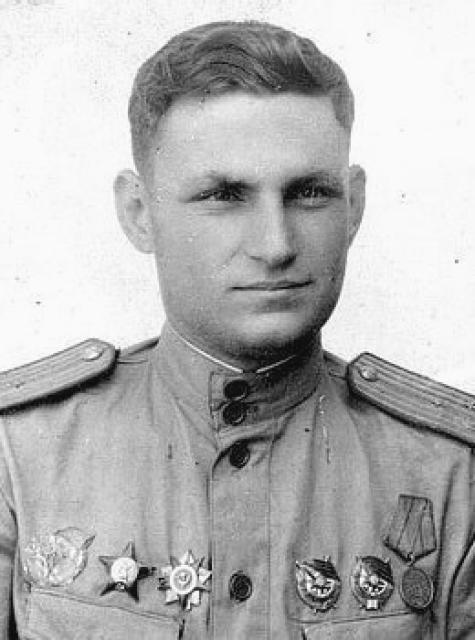
Valentin Shapiro
 Azerbaijan
- Biography of Valentin Shapiro
- The Profession of Fighter Pilot
- The Profession of a Fighter Pilot: Continued
Biography of Valentin Shapiro
Valentin Efimovich Shapiro was born on July 20, 1922, in Batumi, Azerbaijan. He came from a family of military background, as his father held a high position in the border troops before the war. Unfortunately, his father went missing in the early days of the war, most likely killed in the border areas in the Baltic States. Valentin was studying at the Kachalinskaya Flight School at the time, which he successfully completed in the summer of 1942, just as the war approached Stalingrad.
Shapiro began his combat career in the intense battles of Stalingrad. It was extremely challenging for young pilots to adapt to the combat life in the early stages of the war, especially on the Stalingrad front. Only a few of them survived those months, and Valentin Shapiro was one of them. Despite being wounded, he survived and became an experienced and skilled fighter pilot within six months of his combat service.
In May 1945, Senior Lieutenant Valentin Shapiro of the 31st Guards Fighter Aviation Regiment, 6th Guards Fighter Aviation Division, 3rd Guards Fighter Aviation Corps, 5th Air Army, 2nd Ukrainian Front, completed 590 combat missions, including 455 reconnaissance flights over enemy forces, and personally shot down 12 enemy aircraft in 48 aerial battles. For his courage and bravery shown in combat, he was awarded the title of Hero of the Soviet Union on May 15, 1946.
After the war, Shapiro continued his service in the Air Force. In 1950, he graduated from the Military Air Academy and became a commander of an aviation regiment. Since 1978, Colonel Valentin Shapiro has been in reserve. He currently resides in the Balashikhinsky District of the Moscow Region.
Throughout his career, Shapiro was decorated with numerous awards, including the Orders of Lenin, Red Banner (four times), First Class of the Patriotic War (twice), Red Star (twice), and "For Service to the Motherland in the Armed Forces of the USSR" Third Class, as well as various medals.
The Profession of Fighter Pilot
The profession of a fighter pilot is inherently unsuitable for passive, uninitiated, and dependent individuals. It constantly demands the development of opposite qualities. For an aerial reconnaissance pilot, courage and initiative are decisive qualities.
In the 273rd Fighter Aviation Regiment of the 8th Air Army, there were many people who possessed such qualities, but among them, Valentin Shapiro distinguished himself with his coolness and the ability to assess the situation and make unexpected decisions in a matter of seconds. He was the son of a military officer and received excellent upbringing. His father held a high position in the border troops before the war and was among those who took the first blow of the treacherous German invasion into our country. In the most difficult early days of the war, the pilot's father went missing, presumably killed in the border areas of the Baltic States. At that time, Valentin was studying at the Kachalinskaya Flight School, which he successfully completed in the summer of 1942, just as the war approached Stalingrad. Valentin Shapiro began his combat career in the intense battles of Stalingrad. It was extremely challenging for young pilots to adapt to the combat life in the early stages of the war, especially on the Stalingrad front. Only a few of them survived those months, and Valentin Shapiro was one of them. Despite being wounded, he survived and became an experienced and skilled fighter pilot within six months of his combat service.
On one occasion, Shapiro flew with a wingman on a reconnaissance mission to an enemy airfield near Ilovaiskaya station. The task was not easy. The command had learned that the enemy had deployed a new aviation unit to this section of the front. It was necessary not only to determine the number of aircraft based at the airfield but also their affiliation. Reconnaissance of large enemy airfields was always one of the most challenging tasks. Firstly, airfields are usually well protected by anti-aircraft fire, both ground-based and airborne. Secondly, it is difficult to perform such a mission from a high altitude, even in good weather conditions: to identify the identification marks on enemy aircraft, one must descend. And descending over an enemy airfield is not easy, as maneuvers usually occur within the enemy's sight. Even an experienced pilot has a lot to think about before embarking on such a mission.
Shapiro completed this extremely difficult task. Upon returning, he reported in detail and accurately about the number and types of aircraft at the airfield. Although his report did not raise any doubts among the regiment commander, the data he brought back was of utmost importance. It was used for a night bombing strike on the airfield. The regiment commander, Colonel B.N. Eryomin, felt that this flight was quite unusual; apparently, Shapiro, with his inherent restraint, omitted some details that he considered secondary. However, from his report, it could be concluded that he made several approaches to the enemy airfield at very low altitude, and the Germans did not open fire until our reconnaissance aircraft started to move away from the target. This was strange, and the commander asked Shapiro to provide more details. And here, an interesting fact emerged. When Shapiro and his wingman entered the enemy's airfield zone, they were unexpectedly aided by the Germans themselves. But this had to be understood in a timely and correct manner. In short, as soon as our fighters appeared in the enemy's line of sight, Shapiro suddenly heard clearly pronounced Russian words on the radio: "Do you see the landing 'T'?"
A woman asked from the ground. In the given situation, the question sounded quite unexpected – instead of expected Erlikon tracers, concentrated anti-aircraft fire, and possible aerial combat with Messerschmitts...
Had Shapiro been a less experienced pilot, he might have hesitated with his response and not immediately known what to do, thus revealing his doubts. And this would have meant, at best, a failed mission. However, without any hesitation, Shapiro engaged in this strange dialogue: "I see the landing 'T'." A friendly tone came from the ground: "Proceed with landing."
Shapiro instantly understood the convenient opportunity that had unexpectedly presented itself. Pretending to comply with the order, he and his wingman calmly began descending over the enemy airfield. The voice that came from the German radio station seemed to protect them from both anti-aircraft fire and attacks from Messerschmitts. The reconnaissance pilots descended to a very low altitude and passed along the aircraft parking areas. The wingman was slightly higher, while Shapiro flew just above the ground. The parking areas were clearly visible, but the identification marks on the aircraft were impossible to discern due to the high speed.
Then Shapiro made a second approach. He extended the flaps, simulating a landing, and, as he later described, "dragged" the aircraft to its limits, reducing speed. The Yak barely kept itself in the air at a height of no more than one or two meters above the runway. At the end of the strip, to the side, there was an airfield building where several dozen German pilots had gathered. They watched the actions of the Soviet fighter with curiosity, gesturing and talking to each other.
Only Shapiro's high flying skills allowed him to keep the aircraft in the air. At the same time, without interruption, he engaged in a "gossipy" conversation with the woman on the radio, inquiring about various trivial matters, not revealing his tension. He was most concerned that his wingman, with whom he couldn't exchange words, understood him correctly. The wingman was a pilot who had recently returned from the hospital. He was experienced but knew little about his leader. "Therefore," Valentin said, "he might not understand what's going on and make a mistake... I was really imitating a landing almost completely..."
The enemy radio station, not understanding Shapiro's maneuver, suddenly exploded with impatient calls to expedite the landing. But Shapiro, skillfully adjusting speed and altitude, managed to see the enemy aircraft. He began another turn above the airfield – now he had to immediately gain altitude and retreat. Suddenly, there was a hiccup. The reason for the calls from the radio station became clear to Shapiro: a Ju-88 appeared over the airfield and began its landing approach. Everything was falling perfectly into place: Shapiro could pretend to yield to the landing strip for the Ju-88, attack it, and retreat. However, his wingman's nerves failed him – upon seeing the enemy bomber, he suddenly opened fire on it from a very long distance. The Ju-88 turned around and started to leave. Shapiro, acting almost automatically, slightly banked the Yak and fired a long burst at the Germans gathered near the airfield building. Then, while giving the command to his wingman, he swiftly retreated at high speed. The German anti-aircraft guns opened fire with a significant delay...
That's how the mission went... Upon returning, Shapiro drew the configuration of all the aircraft parking areas on the map. The information from his reconnaissance flight was crucial. It was used for a nighttime bombing strike on the airfield. The regiment commander did not request Shapiro to provide more details about this flight without reason. He knew that this pilot was overly restrained in his reports.
The Profession of a Fighter Pilot: Continued
The regiment was stationed near the front line, and our troops were advancing, so the enemy attempted to hinder the offensive with frequent bombings carried out by small groups of Ju-87 and Ju-88 aircraft. It was also possible that a single German bomber or a small group would attempt to bomb our field airfield. Therefore, the command sometimes sent pilots into the air to patrol above the airfield. And once, Valentin Shapiro was called to perform this duty. The regiment commander warned him that he should not leave the airfield area, and the command post would always be in contact with him.
Shapiro circled above the airfield within visual range, and when clouds covered the sky over the airfield, he would be contacted by the command post via radio, and he would report that the situation in the air was calm. Valentin patrolled the airfield alone. The reason for this was that he could handle a single bomber on his own, and if a group approached, he had enough skill to engage them and disrupt their attack, while the regiment commander could immediately send a couple of fighter squadrons to assist him.
Everything was going normally, but suddenly Shapiro did not respond to a call from the commander. The commander waited for a few minutes and repeated the call. This time, Shapiro responded immediately and reported that the situation in the air was calm. When the commander asked why he did not respond to the previous call and where he had gone, Shapiro calmly reported that he did not go anywhere and that the situation in the air was calm. However, the command did not believe him, realizing that he had violated flight discipline, and the flight operations officer decided to give the pilot a thorough "dressing down" after the flight.
Shapiro gracefully performed the landing, reported the completion of the mission, once again stating that the situation in the air was calm. The commander listened to the report and reprimanded him for violating discipline in the air. Valentin received this reprimand completely unfazed. At that moment, the phone suddenly rang, and a representative from the higher headquarters asked to express gratitude to pilot Shapiro. It turned out that when he did not respond to the previous call, the pilot noticed the "Rama" - a German FW-189 reconnaissance aircraft - over the front line. He immediately attacked it and shot it down in the presence of the representative from the Air Army headquarters and the ground command. But since he had indeed been absent from the assigned patrol zone for a few minutes, he preferred not to report the battle immediately... The regiment commander had to adjust his reactions and express gratitude to the pilot, who accepted it with the same characteristic composure...
Valentin Efimovich Shapiro completed 592 successful combat missions and personally shot down 12 enemy aircraft by the end of the war. He was wounded twice. He became a Hero of the Soviet Union. He retired with the rank of Colonel and many of his protégés, whom he guided into the sky, currently serve in the Air Force.