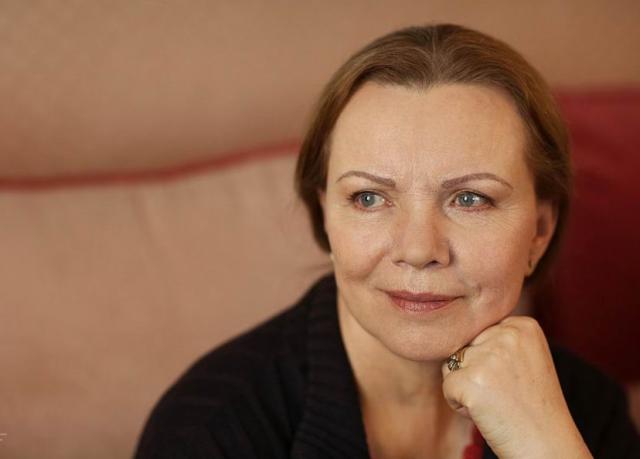
Valentina Telichkina
 Russia
- Валентина Теличкина: A Life in the Arts
- A Childhood of Imagination
- Educational Journey and Early Film Success
- Star-Making Roles and Popular Acclaim
- Artistic Integrity and Career Transitions
- Family and Legacy
Валентина Теличкина: A Life in the Arts
Early Life and InfluencesValentina Telichkina was born in the village of Krasnoe in the Gorky (now Nizhny Novgorod) region. Her father, a kulak or wealthy peasant, suffered greatly under Soviet rule. He was first dispossessed in the 1920s and then faced execution, forcing him to divorce his family to protect them. Despite these hardships, he instilled in Valentina a belief that material possessions were not true wealth.
A Childhood of Imagination
From an early age, Valentina possessed a vibrant imagination and saw the world as a magical place. She would often imagine herself as a character in fairy tales, immersing herself in a world of her own creation. This love of storytelling led her to pursue a career in acting.
Educational Journey and Early Film Success
After graduating high school, Telichkina enrolled in VGIK (Gerasimov Institute of Cinematography), where she studied under the guidance of renowned actor Vladimir Belokurov. In 1965, she made her film debut in the movie "Taiga Airborne Assault." Shortly after, she landed the breakthrough role of Valya in Sergei Gerasimov's "Journalist" (1967), which showcased her talent for portraying ordinary characters with a strong will.
Star-Making Roles and Popular Acclaim
Telichkina became a beloved figure in Soviet cinema, starring in a series of films that showcased her versatility. Her iconic lines as Valya in Gleb Panfilov's "Beginning" (1970) and as Zoya in Nikita Mikhalkov's "Five Evenings" (1979) became memorable quotes. She excelled in complex, nuanced roles, such as Nina in Grigory Chukhrai's "Quicksand" (1977) and Anna in Panfilov's "Vassa" (1982).
Artistic Integrity and Career Transitions
In the 1990s, Telichkina's film roles became less frequent. She followed her principles, refusing to portray characters that compromised her values. Despite financial pressures, she remained steadfast in her artistic integrity. In the late 1990s, she returned to the screen in Viktor Titov's comedy "Kadril" (1999).
Family and Legacy
In recent years, Telichkina has devoted more time to her family, including her husband, an architect, and her son, a student at MGIMO University. While her work in film has been limited, she remains optimistic about the future and looks forward to new opportunities to share her artistry with the world.


