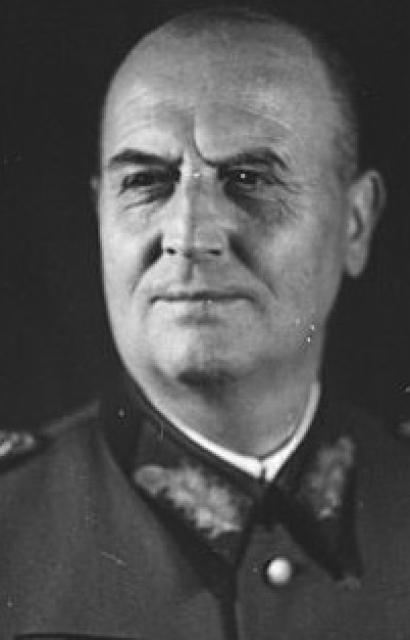
Valter Bule
 Germany
Biography of Walter Buhle
German military figure, infantry general. Walter Buhle (1894-1985) was born in Heilbronn, Württemberg, on October 26, 1894. On July 10, 1913, he joined the imperial army as a Fahnenjunker and in August 1914, he received his first officer rank. After 1918, he remained in the army and served in the 18th Cavalry Regiment and the 13th Infantry Regiment, where Erwin Rommel was the Hauptmann. In 1926, Buhle also became a Hauptmann and was soon assigned to the 4th Cavalry Regiment, and in 1928, he was attached to the Ministry of Defense. He then spent three more years in the 13th Infantry Regiment (1930-1933), where he achieved the rank of Major, and returned to the Ministry of Defense. In January 1936, he was promoted to Oberstleutnant, and in 1937, he became the chief of the operational department of the 5th military district and V Corps. In early 1939, Buhle was promoted to Colonel, and some time later in the same year, due to his intelligence and technical experience, he was given the task of heading the organizational section of OKH. A convinced Nazi, Buhle was awarded the rank of Major General in 1940 for his loyalty and hard work, and two years later, he was promoted to Lieutenant General.
Buhle's Role in the War
Buhle was burdened with great responsibility when he was appointed Chief of Staff of the Army High Command (OKH) in January 1942. However, his constant meddling in other matters and being a trusted informant of Hitler made him disliked by other generals. General Warlimont, noting his personality flaws, wrote that Buhle bypassed Keitel, his immediate superior, and established direct communication with Hitler. Buhle's isolation within the Führer's headquarters, along with his inclination to "stick his nose into everything," did not go unnoticed at a meeting with Hitler on July 25, 1943. The meeting was dedicated to the situation in Italy, which had sharply deteriorated as Mussolini had been ousted the day before. Germany's position in the Mediterranean theater of operations was desperate. While Hitler was discussing the situation with Keitel and Jodl, Buhle interjected that the Italian front should be given priority in terms of transportation supplies. He even insisted that all transportation, including those not yet off the assembly line, be directed to the German forces in the Rome area. He made this recommendation at a time when the Army Group Center and Army Group South were engaged in the largest tank battle in history at Kursk and were in great need of transportation.
Buhle, who was responsible for army transportation, was furious when generals requested reinforcements, as he believed they were interfering with his plans for allocating transportation. In December 1943, at one of Hitler's conferences, he complained that he could only guarantee adequate equipment for tank units in the west if no one took them away. "Just as soon as I manage to equip something," he continued, "it immediately disappears." Hitler angrily asked Buhle if he was hinting at him, to which Buhle naturally denied. His remark was directed at Generaloberst Kurt Zeitzler, who replaced Halder as Chief of the Army High Command in September 1942. Such criticism of the OKH from Buhle and others contributed to Hitler's growing distrust of General Zeitzler. On the other hand, Hitler demonstrated his growing favor towards Buhle by promoting him to General of Infantry on April 1, 1944. That same year, Hitler wanted to appoint him Chief of the General Staff, replacing Zeitzler, but on July 20, Buhle was severely injured in Hitler's headquarters and spent some time in the hospital. Ironically, the assassination attempt was carried out by Colonel Count Claus von Stauffenberg, a talented General Staff officer who had also been one of Buhle's main assistants in organizational management from 1940 to 1942. After initial friction, these two worked together very well, although aristocrat Stauffenberg despised Buhle for his humble origins.
Later Years and Legacy
In January 1945, Hitler appointed Buhle to one of the numerous positions held by Himmler, namely, Chief of Army Armaments. Buhle did everything in his power to provide the necessary supplies for the ground forces. However, the relentless bombings and labor shortages rendered all his efforts futile. Nevertheless, he diligently performed his duty. Interestingly, it was Buhle who accidentally discovered Admiral Wilhelm Canaris's diaries, which contained evidence that the former head of the Abwehr had direct involvement in the conspiracy. On July 20, Buhle handed over the materials to the Gestapo. As a result, the admiral was exposed, sidelined, and hanged on April 9, 1945.
General Buhle managed to survive both the war and the subsequent trials. Released from captivity by the Allies in 1947 or 1948, he moved to Stuttgart, where he lived until 1985.


