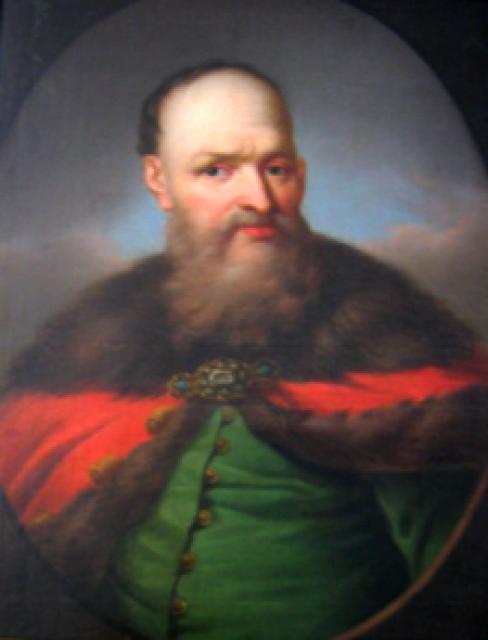
Stefan Charnetskiy
 Poland
- Biography of Stefan Czarniecki
- Captivity and Continued Military Success
- Defense against the Swedes and Contributions to the Commonwealth
- Later Years and Legacy
Biography of Stefan Czarniecki
Early Life and Military CareerStefan Czarniecki was born in 1599 on the family estate of Charnca near the town of Włoszczowa in southern Poland. He came from a modest noble family and received military training in the cavalry corps. Joining the military at the age of 18, he participated in the Battle of Chocim in 1621, where the Ottoman Empire was defeated, marking the end of the Polish-Turkish War. Czarniecki later served under Hetman Stanisław Koniecpolski and took part in campaigns against the Crimean Tatars in 1624, including the Battle of Martynów. He gained military experience in wars against the Swedes and in the Smolensk War. In 1637, he suppressed the uprising of Ukrainian Cossacks led by Pavlo Mykhailovych in the Battle of Kumeyki. In 1644, together with Koniecpolski, Czarniecki fought in the Battle of Akhmatov, where the Polish-Lithuanian Commonwealth inflicted a heavy defeat on the Crimean Khan Tugay Bey.
Captivity and Continued Military Success
On May 16, 1648, Czarniecki, along with many other Polish nobles, was taken captive by Bohdan Khmelnytsky after the Battle of Zhovti Vody. He was sent in chains to Crimea and was ransomed for a large sum of money in 1649. After his release, he actively participated in battles against the Cossacks during the Khmelnytsky Uprising, including the victorious Battle of Berestechko (1651) and the devastating Battle of Batoh (1652). In the latter, he narrowly escaped death by hiding in a haystack and witnessing the execution of several thousand Poles, handed over to the Crimean Tatars. As a result, he always believed that no compromises with the enemies of the Commonwealth were possible.
Defense against the Swedes and Contributions to the Commonwealth
After the invasion of Sweden's King Charles X, Czarniecki distinguished himself in the defense of Kraków. He organized a partisan war, which proved to be a suitable and effective means against the powerful firepower and mobility of the Swedes. Czarniecki inflicted several serious defeats on the Swedes, particularly at Jarosław and Kozenice in 1656, but he himself was decisively defeated by a small Swedish detachment at Hojnice. Ultimately, the popular uprising organized under his leadership against the Swedes ended in success. Thanks to Czarniecki, King John II Casimir was able to return from exile and once again become the head of the state.
Later Years and Legacy
After the departure of the Swedes from Poland and the alliance with Denmark, Czarniecki commanded the forces sent to Jutland to expel the Swedes. After the signing of the Treaty of Oliwa, which settled all Polish-Swedish conflicts, Czarniecki was transferred to the eastern border of the Commonwealth, where a war with Russia was ongoing. In the campaigns of 1660, he commanded Polish troops in the battles of Lachowicze, Połonka, and the Berezina River. In early 1661, the Polish Sejm publicly thanked Czarniecki for his services. King John II Casimir bestowed titles and wealth upon him, and in 1665, he was appointed the Crown Grand Hetman. However, Czarniecki died just six weeks later from a gunshot wound inflicted by the Russians in the Battle of Stavishcha. He was buried in the Charnca family estate in a church he had built. Czarniecki is considered a national hero in Poland, and his name is mentioned in the national anthem.



