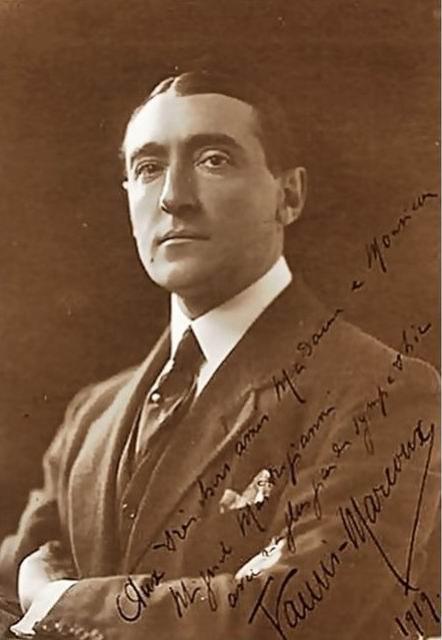
Vanni Marcoux
 France
Biography of Vanni Marcoux
Vanni Marcoux, a French opera singer, was born on June 12, 1877, in Turin, Italy. His father was French, while his mother was Italian. Marcoux was initially named Vanni, a diminutive of the Italian name Giovanni, but later adopted the stage name Vanni Marcoux.

Early Life and Career Beginnings
Marcoux initially pursued a career in law, studying the subject after completing his education. However, his passion for music led him to change his career path. He attended the conservatory in his hometown of Turin, where he honed his vocal skills.

Debut and Success in France and Abroad
Marcoux made his professional opera debut at the age of 17 in Turin, performing the role of Sparafucile in Verdi's "Rigoletto." After further training in Paris under the guidance of Frédéric Boyer, Marcoux made his first appearance on the opera stage in Bayonne, France, in 1899, playing the role of Frère Laurent in Gounod's "Roméo et Juliette." He then performed in several provincial theaters, which eventually led him to London in 1905, where he portrayed Basilio in Rossini's "The Barber of Seville." In 1906, he played the role of Bertram in Meyerbeer's "Robert le diable" at La Monnaie in Brussels.

Marcoux's Paris debut took place in 1908 at the Paris Opéra, where he performed as Méphistophélès in Gounod's "Faust." In 1910, he made his debut at La Scala in Milan as the Old Hebrew in Saint-Saëns' "Samson and Delilah." The same year, he first performed the role of Don Quixote in Massenet's "Don Quichotte" at the Gaieté Lyrique in Paris, which became one of his signature roles.

Throughout his career, Marcoux remained one of the most important figures in the musical life of Paris. He performed mainly at the Paris Opéra and Opéra-Comique, participating in numerous premieres of contemporary operas. He also regularly toured in the United States, debuting with the Boston Opera Company in 1912 as Golaud in Debussy's "Pelléas et Mélisande." In 1913, he made his debut at the Chicago Grand Opera Company, portraying all four villains in Offenbach's "The Tales of Hoffmann," considered one of his greatest achievements.
Later Life and Legacy
In 1914, during the early days of World War I, rumors spread that Marcoux had been killed in battle while serving in the French army. However, he continued his successful career and performed at the Teatro Colón in Buenos Aires, the largest theater in South America, in 1919. Some of his notable performances included the roles of Philippe II in "Don Carlos," Rafaele in "I gioielli della Madonna," Iago in "Otello," and the lead role in "Gianni Schicchi."
In 1938, Marcoux began teaching at the Paris Conservatory, and in 1948, he retired from the stage and became the director of the Grand Théâtre de Bordeaux until 1951. He passed away on October 22, 1962, in Paris.
Vanni Marcoux's exceptional vocal abilities, extensive repertoire, and remarkable dramatic talents made him a beloved and unforgettable figure in the world of opera. His legacy lives on through his recordings and the impact he had on the Parisian opera scene.


