Vasilisa Volohov
- A Court Attendant in Uglich
- The Death of Tsarevich Dmitry
- Rumor, Politics, and Later Memory
- Historical Significance
Vasilisa Volokhova is remembered because she stood beside one of the most consequential mysteries of early modern Russian history. A court nurse and governess to Tsarevich Dmitry of Uglich, she was with the young prince on the day he died in 1591. Her testimony became a central part of the official investigation, while later accusations tied her family to a supposed murder plot. The surviving record, however, does not establish her guilt, and her own account described the death as an accident during an epileptic seizure.
A Court Attendant in Uglich
Very little is known about Volokhova’s early life. No reliable birth or death date is recorded, and the date sometimes attached to her in modern databases is not supported by the historical evidence. She was a widow by 1591 and was serving the household of Maria Nagaya, the last wife of Tsar Ivan IV, commonly known as Ivan the Terrible.
Volokhova held the position of the prince’s mamka, a senior female attendant responsible for his care and upbringing. The term is sometimes translated as nurse or governess, but it did not mean that she was Dmitry’s biological mother. His mother was Maria Nagaya. The other women in the prince’s immediate household included his wet nurse, Arina Tuchkova, and his bedchamber attendant, Maria Kolobova.
Dmitry was the youngest son of Ivan IV and had been sent with his mother and household to Uglich after his father’s death. The boy’s status was politically sensitive: his legitimacy and place in the succession were subjects of dispute at the Moscow court. This made the circumstances of his death especially charged.
The Death of Tsarevich Dmitry
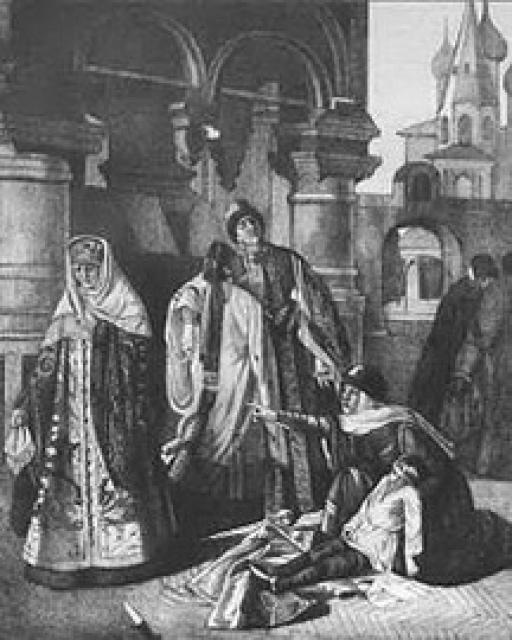
On May 15, 1591, Dmitry was playing in the courtyard of the Uglich residence under the supervision of Volokhova, Tuchkova, Kolobova, and several boys from the household. The prince died from a wound to his throat. Volokhova later told investigators that Dmitry had suffered from recurring seizures, and that during this episode he fell while holding a knife and fatally injured himself.
The explanation was consistent with the conclusion reached by the commission sent from Moscow, headed by the future Tsar Vasily Shuisky: the death was accidental. The commission examined witnesses and events surrounding the prince’s final hours. Volokhova’s testimony was among the fullest accounts in the surviving investigation record, giving historians an unusually direct view of what she said happened.
The immediate aftermath was violent. Maria Nagaya blamed Volokhova’s son, Osip, and other men connected with the Moscow administration. A crowd in Uglich killed several of the accused before the commission arrived. Volokhova’s own testimony says that Nagaya beat her and that she insisted her son had not been in the courtyard. The episode left the household divided between an official finding of accidental death and a local accusation of conspiracy.
Rumor, Politics, and Later Memory
The commission’s finding did not end speculation. Dmitry’s death removed a possible claimant to the throne and became a touchstone in later political struggles. When Boris Godunov was accused of arranging the prince’s murder, Volokhova and her son were incorporated into accounts of a larger plot. Later chronicles and religious narratives sometimes portrayed her as having lured the boy into the courtyard so that assassins could attack him. These accusations became part of a powerful tradition, but they conflict with the account she gave during the investigation and cannot be treated as established fact.
The uncertainty widened during the Time of Troubles, the period of succession crises, uprisings, and civil conflict that followed the end of the Rurik dynasty. Claimants who said they were the surviving Dmitry appeared, and the boy’s death was repeatedly retold to serve changing political purposes. In 1606, Dmitry was canonized by the Russian Orthodox Church, further shaping the religious and cultural memory of his death.
Historical Significance
Volokhova left no known writings of her own, and the circumstances of her later life are obscure. What survives is a small but striking documentary footprint: the record of her position in the prince’s household, her testimony about the seizure and fatal wound, and the accusations that emerged in the emotional turmoil after his death.
Her story illustrates the limits of what can be known about a woman whose life was recorded almost entirely through the crises of a royal court. Volokhova may be cast in later retellings as a conspirator, but the evidence supports a more cautious description: she was Dmitry’s senior female attendant, an eyewitness to his last day, and a witness whose account formed part of an investigation that has never silenced historical debate.