Vasiliy Ermilov
- Early Life and Education
- Avant-Garde Period
- World War I and the "Trio"
- Constructivist and Design Work
- Later Life and Legacy
Early Life and Education
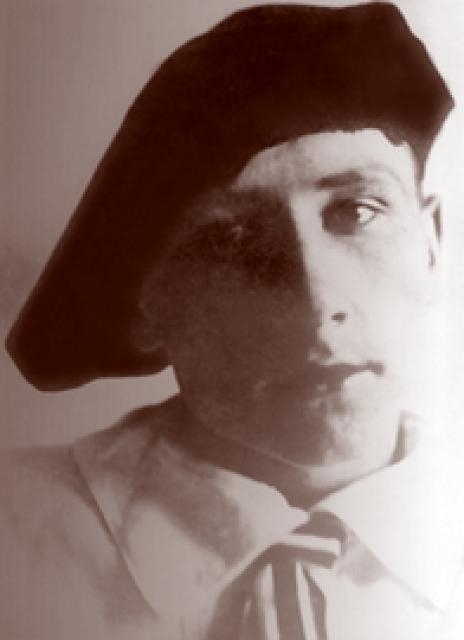
Vasily Dmitrievich Ermilov was born into a tailor's family in the Russian town of Kharkiv. After graduating from a church-parish school in 1905, he pursued his artistic education at the Art and Craft Workshop of Decorative Painting (1905-09). There, he studied under Leonid Trakal and received the title of "master of decorative painting."
Ermilov continued his education at the Kharkiv Art School (1910-11) and the studio of Eduard Shternberg and Alexander Grot. He also took an interest in fresco painting and mosaic.
Avant-Garde Period
In 1911, Ermilov joined the art group "Blue Lily." He then studied at the Moscow School of Painting, Sculpture, and Architecture (1912-13) alongside Vladimir Mayakovsky and David Burliuk. During this period, he worked in the studios of Ilya Mashkov and Pyotr Konchalovsky and took lessons from renowned etcher Georgy Gamon-Gaman.
Returning to Kharkiv in 1913, Ermilov joined the art group "Budyak." In 1914, he received his master's degree in decorative painting from the Kharkiv Art School.
World War I and the "Trio"
From 1915 to 1918, Ermilov served in World War I. He was wounded, concussed, and awarded the George Cross of the 4th degree.
In 1918, he became part of the "Trio" (Alexander Gladkov, Vasily Ermilov, Mane-Katz) that published the album "Seven Plus Three." Ermilov also designed the cover for the journal "Kolossya" in collaboration with the "Seven" group of avant-garde artists.
Constructivist and Design Work
In 1919, Ermilov organized a training workshop in Kharkiv. He designed street and square decorations for May Day and the circus building. He also collaborated with the journal "Paths of Creativity."
From 1920 to 1921, Ermilov led the propaganda department of the Ukrainian Telegraph Agency (UkROSTA) and the painting workshop of the Factory of Artistic Industry. He created propaganda and decorative works for the Red Ukraine Agitprop bureau and designed the streets for the Second Congress of the Comintern.
In 1921, Ermilov developed the artistic design for the agitation train "Red Ukraine." He co-founded the Kharkiv Art and Industry Institute in 1922 and received a Gold Medal at the Leipzig exhibition for his stamp "Aid to the Starving."
Later Life and Legacy
In 1925, Ermilov joined the Association of Revolutionary Art of Ukraine. He participated in the All-Ukrainian Jubilee Exhibition (1927) and the International Exhibition of Printing (1928). He also worked as an art director for the magazine "Avangard" (1928-29), illustrated Soviet journals, and designed interiors.
In later years, Ermilov collaborated with Volodymyr Meller on the design of the Kharkiv Pioneer Palace (1934-35, 1939) and the Pavilion of the Ukrainian SSR at the All-Union Agricultural Exhibition (1937-38).
Ermilov passed away in Kharkiv on January 6, 1968. His works are held in museums in the United States, Germany, and France, and are sold at international auctions such as Sotheby's. A retrospective exhibition was held in Kharkiv in 1962.