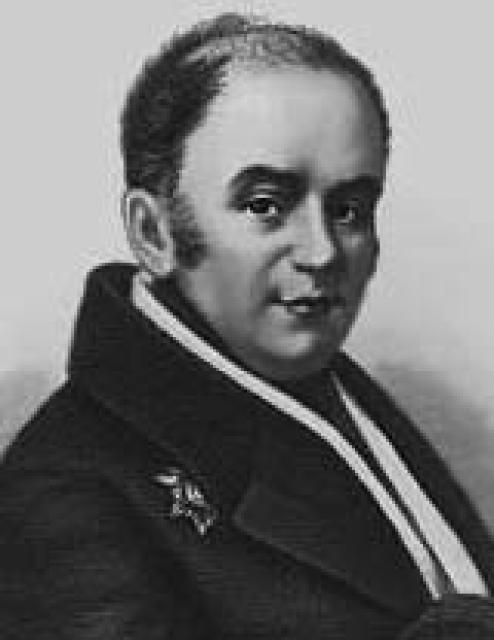
Vasiliy Jukovski
 Russia
- Vasily Andreyevich Zhukovsky: Biography of a Russian Romantic Poet
- Literary Beginnings and Romantic Influence
- Patriotism and Translation
- Courtly Life and Later Years
Vasily Andreyevich Zhukovsky: Biography of a Russian Romantic Poet
Early Life and EducationVasily Andreyevich Zhukovsky was born on January 29, 1783, in Mishenskoye village, near Belev in the Tula province. His mother was a captured Turkish woman, and his father was a local landowner. The family had suffered a tragic loss when his only son died at a young age, and his mother decided to take in the newborn Zhukovsky and raise him as her own.
Zhukovsky's early education proved challenging, and he was expelled from a local school at the age of 11. He then moved to Tula to live with his godmother, where he became surrounded by a circle of cultured individuals who fostered his love for literature and music.
Literary Beginnings and Romantic Influence
In 1797, Zhukovsky made his literary debut with the poem "Thoughts at the Tomb," written after the untimely death of his godmother. This marked the beginning of his career as a poet and translator.
Over the next few years, Zhukovsky's poetry was characterized by sentimental and melancholic themes, reflecting the literary tastes of the time. However, it was his translation of Thomas Gray's "Elegy Written in a Country Churchyard" in 1802 that brought him widespread recognition. This work introduced new elements of simplicity and naturalism to Russian verse.
In 1808, Zhukovsky published his famous ballad "Lyudmila," a retelling of Gottfried August Bürger's "Lenore." This work marked a major shift towards romanticism in Russian literature, emphasizing elements of the supernatural and medieval folklore.
Patriotism and Translation
During the Napoleonic Wars, Zhukovsky's poetry took on a more patriotic tone, as evident in his poem "The Singer in the Camp of the Russian Warriors" (1812). He also translated Friedrich Schiller's "The Maid of Orleans" (1821), contributing significantly to the spread of German literature in Russia.
Courtly Life and Later Years
In 1817, Zhukovsky began his career as a tutor to the imperial princesses. He later became the tutor to the heir to the throne, Alexander Nikolaevich. During this period, he composed fewer original works but excelled as a translator, rendering into Russian classics such as Homer's "Odyssey" and Lord Byron's works.
Zhukovsky's poetry continued to reflect his idealism, melancholy, and yearning for the unattainable. His love for Maria Protasova, who ultimately married another, became a recurring theme.
In the later stages of his life, Zhukovsky became more drawn to mysticism and religion. He visited the West extensively, spending time abroad with literary figures like Nikolai Gogol.
Zhukovsky died in Baden-Baden, Germany, on April 12, 1852. He is remembered as one of the most influential figures in Russian romanticism, instrumental in introducing new literary forms and ideas to the country.


