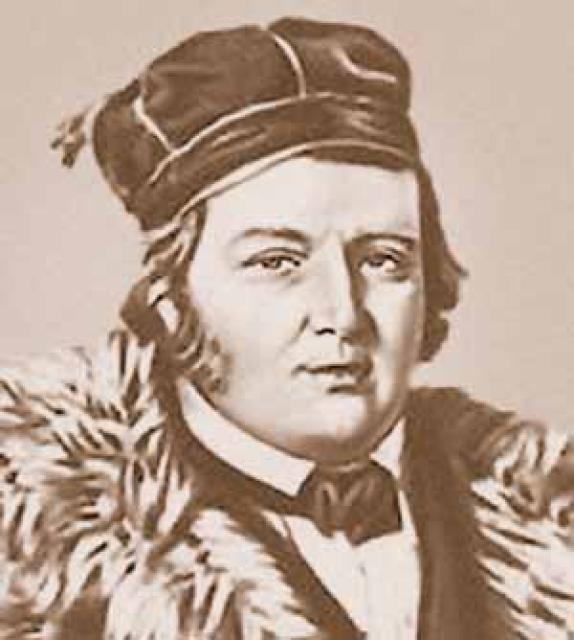
Vasiliy Struve
 Russia
- Birth and Early Life
- Academic Career in Dorpat
- Double Star Measurements
- Founding of the Pulkovo Observatory
- Director of the Pulkovo Observatory
- Impact on Russian Science
- Legacy
Birth and Early Life
Friedrich Georg Wilhelm von Struve was born on April 15, 1793, in Altona, where his father served as the director of a gymnasium. Initially interested in philology, Struve was well-prepared for university entrance at the age of 15.
Academic Career in Dorpat
Struve enrolled at the University of Dorpat (now Tartu), pursuing philology. However, he soon became captivated by the lectures of Johann Gottfried Parrot on physics and astronomy. With the support of Parrot, he switched to astronomy as his major. Despite the university's limited resources, Struve made significant contributions. He published his first paper on the observatory's geographical position in 1813 and was appointed university astronomer-observer. Struve embarked on a geodetic survey, the results of which were published in 1833.
Double Star Measurements
Struve's most notable work began in 1819 when he attached a filar micrometer to an achromatic telescope. He embarked on the systematic measurement of double stars. By 1827, he had published a catalog containing over 3,000 new double star discoveries. Struve's observations spanned 13 years, yielding over 11,000 precise measurements of double star positions. These formed the basis of his influential "Stellarum Duplicium et Multiplium Mensurae Micrometricae" (1837).
Founding of the Pulkovo Observatory
In 1830, the construction of the Pulkovo Observatory was approved. Struve played a pivotal role in its design and the acquisition of world-class instruments. In 1832, he was elected an academician of the St. Petersburg Academy of Sciences.
Director of the Pulkovo Observatory
In 1834, Struve was appointed director of the Pulkovo Observatory. He spent the rest of his life there, overseeing its construction and directing its scientific program. Under Struve's leadership, Pulkovo became a center for observational and research astronomy.
Impact on Russian Science
Struve's contributions were pivotal in establishing a strong astronomical tradition in Russia. His students went on to become prominent astronomers and directors of observatories. Struve also played a vital role in training naval officers and military personnel in practical astronomy and geodesy.
Legacy
Friedrich Georg Wilhelm von Struve passed away on November 23, 1864. His name is inscribed on the Moon's surface in recognition of his contributions to the science of astronomy.




