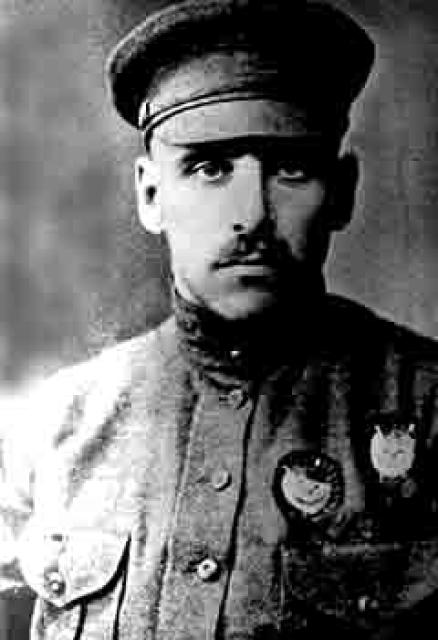
Vasily Bluher
 Russia
Biography of Vasily Bluecher
Vasily Konstantinovich Bluecher (1889, Baryshinka, Yaroslavl Province - 1938, Moscow) was a Soviet military leader, hero of the Civil War, marshal, and 'enemy of the people'.
Early Life
Bluecher was born into a peasant family. His great-grandfather, a serf who had served in the Russo-Turkish War and returned with many awards, was named Bluecher by his landlord after the famous German general of the time. Over time, this nickname turned into a surname. In 1904, after a year of studying in a church parish school, Bluecher's father took him to St. Petersburg for work. Bluecher worked as a "boy" in a store and as a laborer at the Franco-Russian factory, from where he was fired for participating in workers' rallies. In search of work, he moved to Moscow and found employment at a railway workshop in Mytishchi. However, in 1910, he was arrested for inciting a strike and spent almost three years in prison. After his release, Bluecher worked at the Moscow-Kazan railway workshops until he was conscripted into the army in August 1914.
Civil War
During the Civil War, Bluecher distinguished himself as a thoughtful and talented military commander, particularly in the battles for the Kakhovka bridgehead and the Perekop-Chongar operation. He served as a private in the 8th Army under the command of General A. A. Brusilov. Due to his bravery and resourcefulness, Bluecher was promoted to non-commissioned officer and awarded the Order of St. George. In January 1915, he was seriously injured near Ternopil and, after 13 months of treatment, was discharged as an invalid. He worked at a shipyard in Nizhny Novgorod and later moved to Kazan, where he joined the Russian Social Democratic Labor Party (Bolsheviks).
Later Career
In May 1917, Bluecher met V.V. Kuybyshev, who sent him to the 102nd reserve regiment for agitational work. Bluecher actively participated in the Civil War and led a detachment that was sent to the Southern Urals to defeat General A. Y. Dutov. His partisan army embarked on a 40-day raid, covering over 1500 km of territory. The report of the Revolutionary Military Council of the 3rd Army of the Eastern Front noted: "The movement of Comrade Bluecher's troops under impossible conditions can only be compared to Suvorov's marches in Switzerland. We believe that the Russian revolution should express its gratitude and admiration for the leader of this small group of heroes who have written a glorious new page in the history of our young army." In September 1918, the Presidium of the All-Russian Central Executive Committee awarded Bluecher the Order of the Red Banner No. 1. During the Civil War, he continued to display his talents as a thoughtful and talented military commander, earning two more Orders of the Red Banner for his personal bravery and skill in leading military operations.
In 1921, Bluecher was appointed Minister of War and Commander-in-Chief of the People's Revolutionary Army of the Far Eastern Republic. He reorganized the army, strengthened discipline, and achieved victory by capturing the Volochaevsk fortified district. From 1924 to 1927, Bluecher served as Chief Military Advisor in China, and from 1927 to 1929, he was an assistant to the Commander of the Ukrainian Military District. In 1929, he was appointed Commander of the Special Far Eastern Army. In 1930, Bluecher became the first recipient of the Order of the Red Star and was awarded the Order of Lenin. In 1935, he was granted the rank of Marshal of the Soviet Union.
Arrest and Death
In July 1938, during the fighting near Lake Khasan, the Soviet troops suffered significant losses due to mistakes made by the commanding officers. The High Military Council, including K.E. Voroshilov, S.M. Budyonny, V.M. Molotov, and I.V. Stalin, noted that "significant shortcomings were revealed in the condition of the Far Eastern Front" at Lake Khasan. These shortcomings were the result of continuous "purges" within the army. Among others, Bluecher was accused of "failing or not wanting to thoroughly cleanse the front of enemies of the people." In 1938, Bluecher was arrested for participating in a "military-fascist conspiracy" and died in Lefortovo Prison. In March 1956, the Main Military Prosecutor's Office informed Bluecher's son that the charges against his father had been "falsified by the enemy of the people Beria and his accomplices". In 1956, Bluecher was posthumously rehabilitated.



