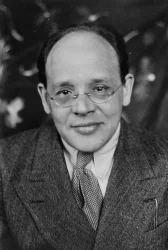
Vasily Grossman
Vasily Grossman spent more than a thousand days with the Red Army during the Second World War, reporting from battles that would reshape the Soviet Union and from Nazi camps that revealed the scale of the Holocaust. He turned those experiences into journalism and fiction, but his most ambitious novel, Life and Fate, was seized by Soviet authorities before publication. He died without seeing the book reach readers, and its journey into print became part of the story of his resistance to state control.
Early Life and Writing
Grossman was born on 29 November 1905 in Berdichev, a Ukrainian town with a large Jewish community. His parents were educated and largely assimilated. His mother, Yekaterina, taught French; his father, Semyon, was a chemical engineer. Grossman studied in Kyiv and then chemistry at Moscow State University. After graduating in 1929, he worked in the Donbas coal-mining region as an engineer and safety inspector, and also taught chemistry.
While working in industry, he began writing fiction. His short story In the Town of Berdichev, published in 1934, brought him attention and encouragement from prominent Soviet writers. He followed it with fiction about miners and industrial life, including the novel Glyukauf. His education in chemistry and years in the Donbas gave him a detailed feel for technical work and ordinary people under pressure—elements that would later appear in his large-scale novels.
War Correspondent
When Germany invaded the Soviet Union in 1941, Grossman became a correspondent for the Red Army newspaper Krasnaya Zvezda, or Red Star. He covered the chaotic early retreats, the defense of Moscow, the brutal fighting at Stalingrad, the Battle of Kursk, and the Soviet advance westward to Berlin. His reports were read by soldiers and civilians alike, and his direct style made him one of the most respected frontline writers of the war.
The war also brought personal catastrophe. German forces occupied Berdichev, where Grossman’s mother had remained. She was murdered in September 1941 with thousands of other Jews from the city. Grossman learned the details after the Red Army retook the region. Her fate haunted him, and he later wrote an imagined letter from a mother facing death in a ghetto in Life and Fate, giving private grief a place within the history of mass murder.
In 1944, Grossman entered Treblinka after its liberation and wrote The Hell of Treblinka, an eyewitness account of the extermination camp. It was among the earliest detailed reports to convey to a broad public the mechanics and scale of a Nazi death camp. He also worked with Ilya Ehrenburg on The Black Book, a collection of testimony and documentation about the murder of Jews in Nazi-occupied Soviet territories and Poland. The project was eventually suppressed by Soviet authorities, and its publication in the Soviet Union was blocked.
Novels and Censorship
Grossman transformed his wartime experience into a major two-part literary project. For a Just Cause, published in 1952 after extensive editorial pressure and revision, followed a family and soldiers during the approach of the Battle of Stalingrad. Its companion, Life and Fate, widened the frame to include the battle, the Holocaust, the Gulag, and the machinery of both Nazi and Soviet totalitarian rule.
Grossman completed Life and Fate around 1960. The novel’s comparison of Nazi and Soviet systems, along with its frank treatment of state terror and antisemitism, made it unacceptable to the authorities. The KGB seized the manuscript and associated materials, and Soviet officials told Grossman that the book could not be published for decades. The episode was especially bitter because the same writer had once been celebrated for accounts of Soviet military courage.
The manuscript was not entirely lost. A copy survived outside the materials seized from Grossman, and after his death it was reproduced and smuggled to the West with the help of dissident writers and scientists. Life and Fate was first published abroad in 1980, sixteen years after Grossman’s death. Soviet readers did not see a full publication until the era of glasnost.
Final Years and Legacy
Grossman continued writing after the war, even as his work faced increasing restrictions. His later novel Everything Flows addressed Soviet labor camps, collectivization, famine, antisemitism, and the loss of freedom. It remained unpublished in his lifetime. He died in Moscow on 14 September 1964, after a long illness, with his most important work still withheld from readers.
Grossman’s reputation grew as his novels and essays became available outside the censorship system. Life and Fate is now widely regarded as one of the major literary accounts of the twentieth century’s wars and dictatorships. His importance rests not only on the scale of his fiction but also on the discipline of his witnessing: he documented the front, the camps, and the human beings caught between systems that claimed power over every part of life.