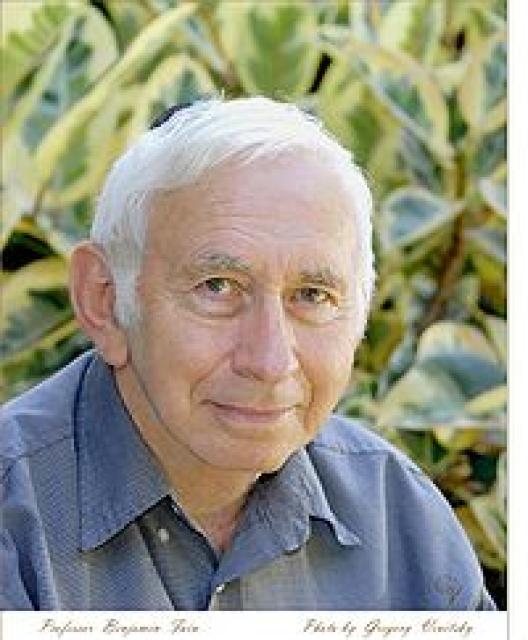
Veniamin Fayn
 Russia
- Veniamin Fein: A Life in Physics and Dissent
- Academic Career and Scientific Contributions
- Zionist Activism and Dissent
- Emigration to Israel
- Later Years and Philosophical Pursuits
Veniamin Fein: A Life in Physics and Dissent
Early Life and EducationVeniamin Fein was born on February 17, 1930, in Kiev, into a Jewish family. His father, a mathematician, instilled in him a love of science and a strong sense of national identity. After evacuating during the war, the family settled in Dushanbe, where Fein completed high school. In 1948, he enrolled in the Moscow Power Engineering Institute, demonstrating exceptional aptitude in physics.
During his undergraduate studies, Fein began attending a synagogue, where he was inspired by the historic visit of Israel's first ambassador, Golda Meir. He also attempted to learn Hebrew and Yiddish. In 1950, Fein transferred to the physics faculty of Gorky University, graduating with honors in 1954 and becoming an assistant there. Among his teachers was future Nobel laureate Vitaly Ginzburg, who became Fein's scientific advisor.
Academic Career and Scientific Contributions
Fein earned his Ph.D. in 1964 and became a professor in 1965. As the head of the department of quantum radiophysics, he made significant contributions to the field. His book, "Quantum Radiophysics," was translated into English and German. He also published "Photons and Nonlinear Media" and numerous articles.
In 1966, Fein moved to the Institute of Solid State Physics in Chernogolovka, where he continued his successful research.
Zionist Activism and Dissent
From 1972 onwards, Fein actively participated in the Zionist movement in the USSR, becoming involved in the samizdat movement and attending a seminar for scholarly refuseniks. He applied to emigrate only after his daughter and first wife departed in 1974.
In the early 1970s, Fein became increasingly religious, gravitating towards Orthodox Judaism. He married his second wife, Susanna Rozhanskaya, in 1976. That same year, he conducted a sociological study of Soviet Jewry and attempted to organize an international symposium on the subject. The KGB disrupted the symposium, leading to significant repercussions and intensifying Fein's conflict with the authorities. After being dismissed from his job, he became an unemployed and persecuted refusenik.
Emigration to Israel
After a period of intense struggle, Fein received permission to leave the USSR and arrived in Israel in 1977. In Israel, he continued advocating for Soviet Jewry while also resuming his scientific research at Tel Aviv University in the chemistry department. His research interests included quantum electronics, laser physics, and condensed matter.
Later Years and Philosophical Pursuits
In his later years, Fein turned to philosophical inquiry, exploring the relationship between science and religion in his book "Yesh Me'ayin" ("Creation Ex Nihilo"). The book garnered attention for its philosophical and autobiographical elements. He also completed a second book in Hebrew, "Laws of Nature and Divine Providence."
Veniamin Fein's life was marked by his scientific achievements, his activism for Jewish rights, and his ongoing exploration of the fundamental questions of existence. He passed away in 2015, leaving behind a legacy of intellectual curiosity, moral courage, and deep commitment to his faith and people.


