Vensan Endi
 France
- Early Life and Education
- Musical Influences and Allies
- Symphonic Works and German Influence
- Operas and Other Compositions
- Schola Cantorum
- Pedagogical Influence and Legacy
Early Life and Education
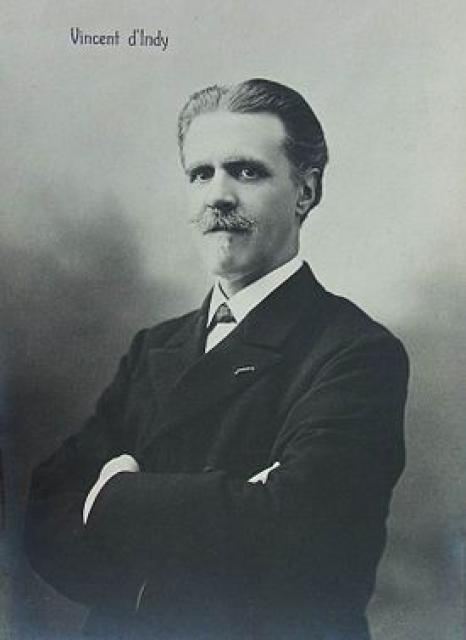
Paul Marie Théodore Vincent d'Indy was born on March 27, 1851, in Paris, France. Raised by his grandmother, a woman of strong character and an avid music lover, d'Indy received musical instruction from J.F. Marmontel and A. Lavignac.
His formal education was interrupted by the Franco-Prussian War (1870-1871), during which d'Indy served in the National Guard. Upon its conclusion, he joined the newly founded National Music Society, aimed at revitalizing French music.
Musical Influences and Allies
D'Indy became acquainted with Georges Bizet, Jules Massenet, and Camille Saint-Saëns. However, he forged the closest bond with César Franck, becoming his student, biographer, and ardent advocate.
A trip to Germany, where d'Indy met Franz Liszt and Johannes Brahms, reinforced his pro-German sentiments. A visit to Bayreuth in 1876 turned him into a convinced Wagnerian.
Symphonic Works and German Influence
These influences manifested in d'Indy's symphonic trilogy inspired by Schiller's "Wallenstein" and his cantata "Le Chant de la Cloche." The "Symphonie cvnole" (1886) marked a shift towards French folklore and a departure from his previous German fascination.
Operas and Other Compositions
D'Indy's musical legacy includes two operas: the Wagnerian "Fervaal" (1897) and "L'Etranger" (1903). He also composed the symphonic variations "Istar" (1896), the Second Symphony in B-flat major (1904), the symphonic poem "Jour d'été à la montagne" (1905), and four string quartets.
Schola Cantorum
In 1894, d'Indy co-founded the Schola Cantorum with Charles Bordes and Alexandre Guilmant. Initially intended for studying and performing sacred music, the Schola evolved into a prestigious music education institution, rivaling the Paris Conservatory.
Pedagogical Influence and Legacy
D'Indy assumed a leading role at the Schola, championing traditionalism against the innovations of composers like Debussy. His composition classes attracted students from across Europe.
D'Indy's aesthetics drew inspiration from Bach, Beethoven, Wagner, Franck, Gregorian chant, and folk song. His artistic philosophy was rooted in the Catholic concept of art's purpose. Paul Marie Théodore Vincent d'Indy passed away in Paris on December 2, 1931.