Victor Lidio Jara Martinez
 Chile
ChileBiography of Victor Jara Martinez
Victor Lidio Hara Martinez was a Chilean poet, singer, and political activist who tragically died during the military coup in 1973. He was born into a peasant family and later moved from the village to the slums of the capital city, Santiago. Despite the poverty and difficult life in his family, Victor received a secondary education. His mother, an illiterate indigenous woman from southern Chile, was determined to ensure her children received a proper education. Victor was sent to a Catholic school where he developed a passion for the arts.
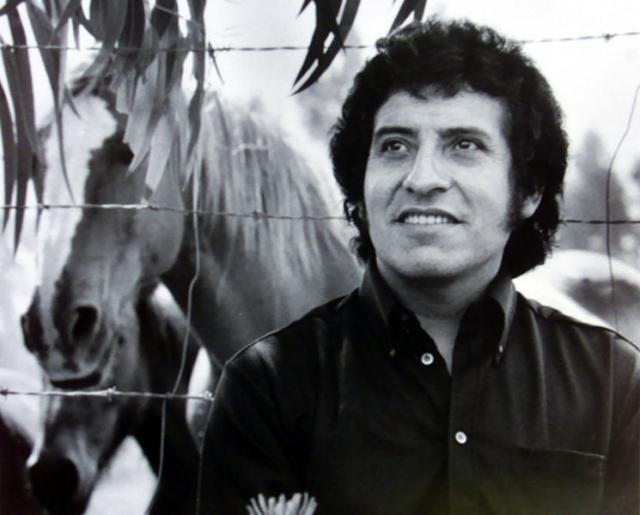
After finishing school, Victor initially wanted to become a priest but eventually pursued a career in acting. He spent several years performing in pantomime theater and traveling to Chilean villages, collecting traditional folk music. He then enrolled in a theater school to become a professional actor. It was there that he showcased not only his acting talent but also his musical abilities, becoming part of a circle of artists and intellectuals centered around the poet Pablo Neruda.
Victor's breakthrough came when he released a collection of traditional folk songs, recorded with the folk group "Cuncumen" - a band made up of radical youth. He also gained recognition for his play "Parecido a la Felicidad" ("Resembling Happiness"), which was highly popular and performed in several Latin American countries, including Cuba, where Victor met Che Guevara. In 1961, Victor visited the Soviet Union and other European countries as part of a tour organized by the Communist bloc. In his letters to his wife, he expressed admiration for the resilience of the Russian people in the face of their challenging lives.
During the 1960s, Victor became the director of the Chilean State Theater. While he mainly worked on plays by other authors, he also sought to express his love for Chilean peasants and the impoverished inhabitants of the slums through vivid and lifelike portrayals of their lives on stage. This was an opportunity for Victor to reflect the conditions in which he was born and raised. However, in doing so, he also highlighted political issues, as the poor and indigenous people were often portrayed negatively or as faceless characters in plays by other playwrights. Victor rejected such discrimination and aimed to restore their dignity on stage, using his theater to give voice to the people.
During this time, Chile experienced a political divide between left-wing and right-wing forces, supporters and opponents of social reforms. The goal of the "Popular Unity" coalition, which included communists, socialists, and progressive Christian parties, was to improve the lives of the poor in Chile through the establishment of a socialist system. The right-wing National Party, representing the ruling elite of large landowners, opposed these reforms by any means necessary, including violence against their opponents. Victor, as a member of the Chilean Communist Party, sided with the left, a choice directly linked to his humble background.
In 1970, Salvador Allende, the candidate from the "Popular Unity," was elected president, and Victor's song "Venceremos" ("We Will Win") became the anthem of Allende's presidential campaign. After Allende's election, the Chilean army, led by General Schneider, issued a statement committing to respect and protect democracy. However, a few days later, General Schneider was fatally wounded by a member of a right-wing terrorist group and died in the hospital.
Victor found himself at the center of events, writing and performing his new songs everywhere. However, Chile faced new challenges as both left-wing and right-wing extremists attacked the democratically elected government. Victor was deeply disturbed when left-wing terrorists killed Peres Zujovic, the Minister of the Interior. Meanwhile, the right-wing "Patria y Libertad" ("Homeland and Liberty") organized street fights. Victor himself became the target of several unsuccessful attacks.
In 1973, the "Popular Unity" won the parliamentary elections with an unprecedented percentage of the vote. However, instead of celebrating their victory, Allende warned Chileans of the impending threat of a fascist coup and civil war. Victor hosted a television series titled "I Don't Want My Country to be Divided" about the Spanish Civil War and Nazi Germany, drawing parallels to the situation in Chile.
On June 25, the "Patria y Libertad" attempted a military coup, but it was stopped by General Prats, who blocked a tank column heading towards the presidential palace. The leaders of "Patria y Libertad" sought asylum in the Ecuadorian embassy. In the following months, General Prats was forced to resign, and a mediator in negotiations between the Chilean navy and the government was killed. Finally, on September 11, 1973, the Chilean armed forces, led by General Pinochet, staged a coup. Military intelligence squads arrested anyone affiliated with the "Popular Unity" party or suspected of opposing them, bringing them to stadiums.
Victor Jara was taken to Estadio de Chile, the largest stadium in Santiago. After days of torture, he was executed. He left a small note with a poem titled "In the Stadium," which was secretly smuggled out. Officially, Victor Jara was classified as one of the "disappeared," one of the thousands of actual and potential opponents of the military regime whose murders were concealed from the public. Victor's body was identified by those responsible for burying him in a mass grave. His wife, Joan, retrieved his body and gave him a proper burial.
Following the coup, Victor's music was banned, and all recordings were destroyed. Repression extended to the point of banning traditional instruments and folk music to eliminate any possibility of playing his music. Joan, being a British citizen, was evacuated with their children through the efforts of British diplomacy. She wrote this book, published in the United Kingdom in English. Victor Jara's music and songs, known throughout Latin America, became part of the resistance against the Chilean military dictatorship and other dictatorships in Latin American countries.