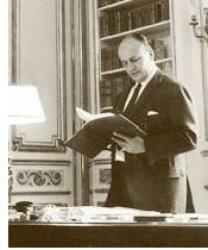
Victor Vasarely
 France
- Early Life and Education
- Career Beginnings
- Artistic Periods
- Op-Art Movement
- International Recognition
- Foundation and Legacy
Early Life and Education
Victor Vasarely, a French artist of Hungarian descent, was born in 1906. He completed his schooling in 1925 and embarked on an artistic career at the Poldi-Volkmann Academy of Fine Arts in Budapest in 1927. In 1928, he moved to the Mühely Atelier in Budapest, where he studied under Sándor Bortnyik and Lászlo Moholy-Nagy.
Career Beginnings
In the late 1920s, Vasarely became a student at the Bauhaus, immersing himself in the world of modern art. In 1930, he married and relocated to Paris, where he spent a decade working in advertising agencies as an artist and graphic designer. His artistic focus shifted to painting in 1944.
Artistic Periods
Belle-Île (1947):Vasarely experimented with circular and ellipsoidal forms, showcasing his interest in optical illusions.
Gordes-Crystal (1948):He relocated to Gordes and focused on creating ambiguous and multifaceted compositions.
Denfert (1951):Inspired by the architecture of the Denfert-Rochereau station in Paris, Vasarely's works became more geometric and architectonic.
Op-Art Movement
In 1955, Vasarely published the "Yellow Manifesto," which outlined the principles of Op-Art, a movement that creates optical illusions through geometric patterns and bold colors. He created kinetic works, architectural installations, and designs for carpets and cinema.
International Recognition
Vasarely's work gained international acclaim in the 1950s and 1960s. He won prestigious awards, including the Guggenheim Prize in 1964 and was knighted in the Order of Arts and Letters in 1965. In 1969, he received a professorship at the University of Applied Arts in Budapest, and the Vasarely Museum was established in the Zichy Castle in Budapest.
Foundation and Legacy
Vasarely established the Vasarely Foundation and Museum in Gordes in 1970. His legacy as a pioneer of Op-Art continues to inspire artists around the world.