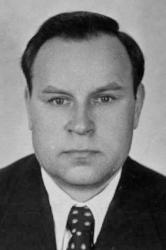
Viktor Abramov
 Russia
- Early Life and Career
- Encounter with Revolutionaries
- Involvement with Plehve's Assassination
- Significance of the Solomensky District
- Decline and Dissolution
- Arrest and Imprisonment
- His subsequent fate remains unknown.
Early Life and Career
Ivan Georgievich Abramovwas born in Kiev, Ukraine, into a family of coachmen. After his father's death when he was seven, he was apprenticed to a railway depot three years later. As an adult, he acquired skills as a locksmith, coppersmith, and metalworker.
From 1880, he worked in railway workshops in Zhmerynka and Birzula, and briefly in Odessa. In 1900, Abramov moved to Kiev, where he held various locksmith positions, including at the Greter and Krivanek plant, the Miller factory, the water supply service, and finally the fire brigade of the Staro-Kievsky district.
Encounter with Revolutionaries
In 1902, Abramov used his savings to purchase musical instruments and assembled a small orchestra of impoverished musicians from Chernigov. This venture failed, however, when the Chernigov police confiscated and sold the instruments and uniforms. Abramov incurred losses of 3,000 rubles.
During his work, Abramov came into contact with the revolutionary underground and learned of their plans. In 1903, he wrote a letter to Interior Minister V. K. Plehve, warning him of an assassination plot. He expressed his desire to provide information secretly to avoid retaliation.
Involvement with Plehve's Assassination
A locksmith in Abramov's workshop, V. D. Boyko, turned out to belong to the revolutionary underground and had confided in Abramov. Boyko showed him a hidden box containing illegal literature and a picture depicting the beheaded bodies of a king and queen holding their heads in their hands. Boyko threatened Abramov with retaliation if he reported him.
Abramov confirmed these details on August 15, 1903, in an interrogation by Lieutenant Eremein. He also handed over several revolutionary publications to officials, including newspapers and leaflets.
His testimony resulted in Boyko's arrest and a trial.Abramov did not receive any reward for his information, despite his financial need. Moreover, he was dismissed from his job in October 1904.
Establishment of the Solomensky District of the Russian People's Union
Despite these setbacks, Abramov remained loyal to the Tsarist regime and became active in patriotic movements. In 1909, he founded the Solomensky District of the Russian People's Union (RNSMA).
The organization aimed to unite workers in the Kiev suburbs and instill loyalty to monarchist ideals. It provided employment opportunities, opened a consumer cooperative, a daycare, a school, a fire brigade, and legal aid services.
Significance of the Solomensky District
The Solomensky District played a significant role in uniting artisans and workers based on their profession. It established the Union of Locksmiths, the Union of Cab Drivers, and the Union of Homeowners. These organizations aimed to combat Jewish influence in various trades.
In 1911, Abramov was granted permission to attend the Tsar's visit to Kiev. By 1912, the Solomensky District had over 400 members.
Decline and Dissolution
However, in late 1912, the RNSMA's central headquarters stopped funding the Solomensky District, and it dissolved in 1913. Abramov resumed temporary locksmith work to make ends meet.
Arrest and Imprisonment
In 1924, the former leadership of the Solomensky District was arrested and charged with secret service activity. The authorities reopened the case in 1925, and in 1926, Abramov was sentenced to eight years of imprisonment with strict isolation and the confiscation of his property.