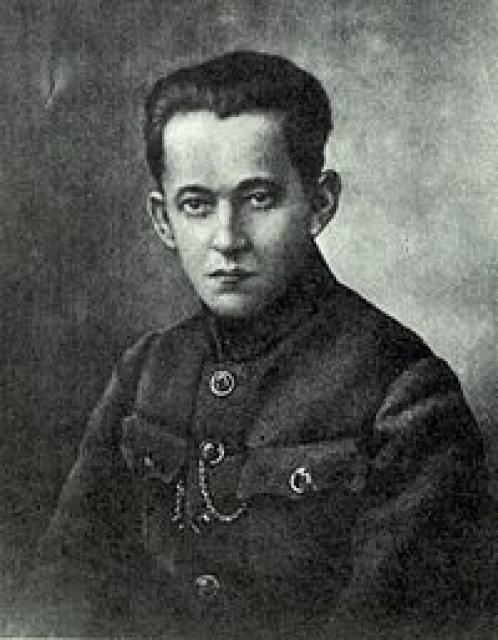
Vincas Kreve
 Lithuania
- A Multifaceted Lithuanian Literary Icon: Vincas Krėvė
- Return to Lithuania and Literary Career
- Later Years and Literary Legacy
- "Šarūnas" (1911) - A drama
- "Skirgaila" (1925) - A historical drama
A Multifaceted Lithuanian Literary Icon: Vincas Krėvė
Early Life and EducationVincas Krėvė was born on October 19, 1882, in Subartonys village, Lithuania. Originally bearing the surname Mickevičius, he later adopted Krėvė as his pseudonym after the village's nickname for the Mickevičius family. Krėvė received his early education from a local teacher and in Merkinė, before pursuing private studies in Vilnius. He passed his secondary school examinations in 1898 and enrolled in the Vilnius Theological Seminary, where he remained for two years before realizing his lack of a vocation for priesthood.
In 1904, Krėvė entered the University of Kiev to study philology. He continued his studies at the University of Lviv in 1905 and completed his doctorate in philology there in 1908. He also passed examinations at Kiev University and was invited to pursue a professorship. However, Krėvė left academia due to meager pay and relocated to Baku, Azerbaijan, where he taught Russian language and literature at a local high school. In 1913, he defended his dissertation at Kiev University, earning a master's degree in comparative linguistics.
Return to Lithuania and Literary Career
After representing Lithuania in Azerbaijan in 1919, Krėvė returned to his homeland in 1920. He settled in Kaunas, then the capital of Lithuania, and played an active role in its cultural and political life. He served as secretary of the book publishing commission in the Ministry of Education, edited the literary magazine "Skaitymai," taught at the University of Lithuania, and became the dean of its Faculty of Humanities from 1925-1937. Krėvė also actively participated in politics, briefly serving as Minister of Foreign Affairs in 1940.
Later Years and Literary Legacy
After the Soviet occupation of Lithuania, Krėvė retreated from politics and focused on his academic work at the University of Vilnius, where he was appointed director of the Institute of Lithuanian Studies. In 1944, he fled to the West and spent time in Austria. He eventually settled in Philadelphia, USA, in 1947, where he taught Russian and Polish languages and literature at the University of Pennsylvania. Krėvė passed away in Springfield in 1954 and was reburied in his homeland in 1992.
Throughout his career, Krėvė showcased his literary versatility across multiple genres. His works combined elements of realism and romanticism, with historical dramas, interpretations of Biblical texts, and folkloric influences. His notable literary contributions include:
"Šarūnas" (1911) - A drama
"Dainavos šalių senų žmonių padavimai" (1912) - A collection of stylized legends
"Šiaudinės pastogės" (1921-1922) - A three-volume collection of novellas
"Skirgaila" (1925) - A historical drama
"Mindaugo mirtis" (1935) - A historical drama"Miglose" (1944) - A novel
"Dangaus ir žemės sūnūs" (posthumously published) - A biblical epic




