
Vinton Cerf
 USA
USABiography of Vint Cerf
Vint Cerf, also known as the "Father of the Internet," is renowned for his contribution to the development of the TCP/IP protocol alongside American engineers Bob Kahn and Donald Davies. He was born on June 23, 1943, in New Haven, Connecticut, to a homemaker mother and a manager in the aerospace industry.

Cerf attended Van Nuys High School in California, where he studied alongside Jon Postel and Steve Crocker. He wrote an obituary for Crocker later in his life. After earning a Bachelor of Science degree in Mathematics from Stanford University, Cerf worked as a systems engineer-programmer at IBM for two years, supporting the development of the QUIKTRAN programming language. He left IBM to pursue a Ph.D. at the University of California, Los Angeles (UCLA), where he earned his master's degree in 1970 and his Ph.D. in 1972. During this time, Cerf studied under Professor Gerald Estrin and collaborated with Professor Leonard Kleinrock, who was connecting UCLA to ARPANet, the predecessor to the Internet. His work on ARPANet led him to meet Bob Kahn.
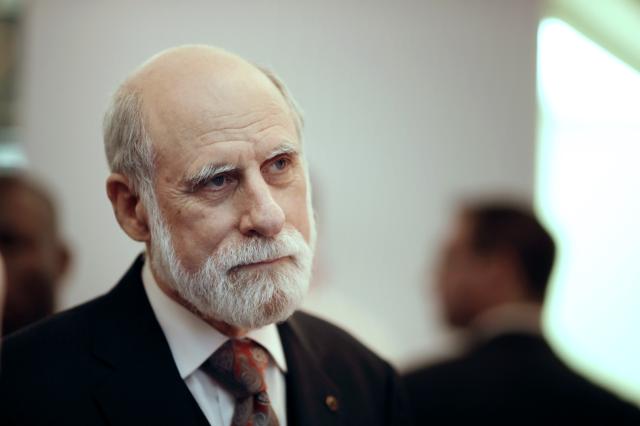
From 1972 to 1976, Cerf served as an assistant professor at Stanford, where he researched internetworking protocols and collaborated with Kahn to develop the TCP/IP protocol suite, a practical implementation of the Defense Advanced Research Projects Agency (DARPA) model. In 1976, Cerf joined the United States Defense Advanced Research Projects Agency (DARPA), where he stayed until 1982. He then served as the Vice President of the Electronic Information Services Division at MCI from 1982 to 1986, leading the development of the first commercial email service, MCI Mail, connected to the Internet.
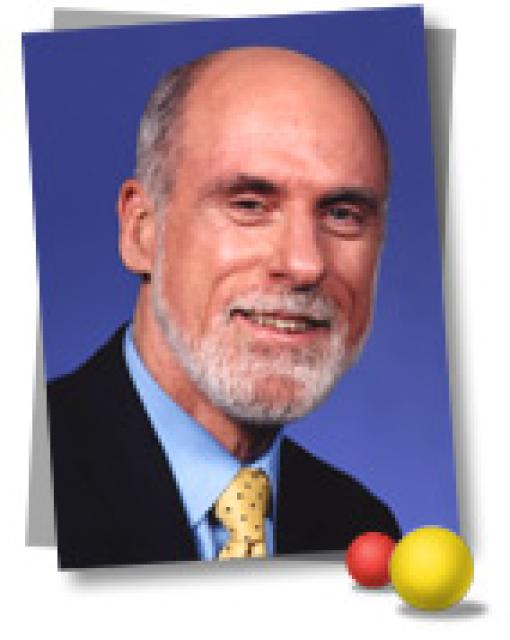
In 1992, Cerf and Bob Kahn co-founded the Internet Society (ISOC), an international professional organization dedicated to the development of the Internet. In 1997, he joined the Board of Trustees of Gallaudet University, a university specializing in educating deaf and hard of hearing students. In October 2005, Cerf assumed the roles of Vice President and "Chief Internet Evangelist" at Google, where he gained widespread recognition for his predictions about the impact of new technologies on society. He spoke on topics such as artificial intelligence, environmental protection, the emergence of the IPv6 protocol, and the transformation of the television industry.
Starting in 2010, Cerf became the official representative to the United Nations Broadband Commission for Digital Development, a commission aiming to make broadband Internet access technologies more accessible. He also collaborated with NASA's Jet Propulsion Laboratory on the "Interplanetary Internet" project to provide deep space communication. The first successful tests of the Delay/Disruption Tolerant Networking (DTN) architecture were conducted in November 2008, with the Deep Impact spacecraft receiving information from NASA specialists.
In February 2006, Cerf testified before the United States Senate Committee on Commerce, Science, and Transportation as the "chief evangelist" of Google. He highlighted that nearly half of all consumers lack a real choice in broadband service providers and expressed concerns about the absence of government regulation on network neutrality, which could allow broadband providers to limit consumer capabilities and decrease bandwidth.
In addition to his numerous honorary degrees, Cerf was appointed an honorary fellow of the British Computer Society in September 2011 for his outstanding contributions to the development of computer technology. In 2012, he was inducted into the Internet Hall of Fame as one of the "Fathers of the Internet." He was also one of the five "Internet Pioneers" and "Web Founders" awarded the Queen Elizabeth Prize for Engineering in 2013. In 2014, Cerf received the Order of the Cross of Terra Mariana from Estonian President Toomas Hendrik Ilves for his key role in the development of the TCP/IP protocol suite.
Cerf is known for his distinctive three-piece suit attire, which is uncommon in the computer industry where casual clothing typically prevails.