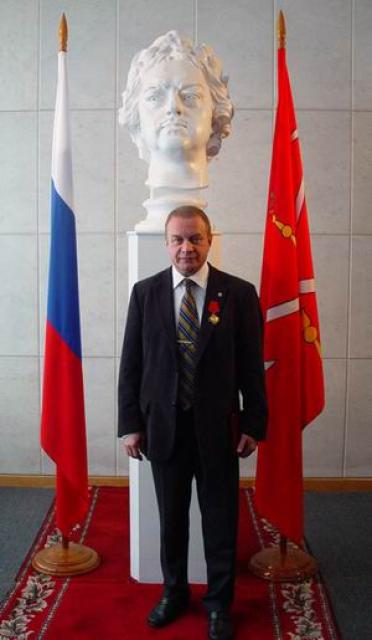
Vitaliy Lopota
 Russia
- Vladimir A. Lopota: A Visionary Leader in Aerospace and Robotics
- Early Career and Research
- Regenerating the Institute
- Groundbreaking Innovations
- - Robotic manipulators for assembling and operating space stations
- International Collaboration and Industry Recognition
- Scientific Achievements and Honors
- - Merited Scientist of the Russian Federation
Vladimir A. Lopota: A Visionary Leader in Aerospace and Robotics
Early Life and EducationVladimir Anatolyevich Lopota was born on September 28, 1950, in the city of Grozny. In 1978, he graduated with honors from the Leningrad Polytechnic Institute (now Saint Petersburg State Polytechnic University).
Early Career and Research
In 1984, Lopota established the research laboratory for laser and electron beam technologies under the USSR Ministry of Defense. From 1985 to 1991, he led research efforts on laser technology in defense industry enterprises. In 1986, he founded the Department of Laser Technology at Saint Petersburg State Polytechnic University and established the Center for Laser Technology (CLT) in 1987. CLT implemented several major programs for the defense industry and continues to provide advanced laser technological solutions to various industries.
Director-General Designer of the Central Research Institute for Robotics and Technical Cybernetics (CNIITTK)
Regenerating the Institute
On December 23, 1991, Lopota became the Director-General Designer of CNIITTK. Under his leadership, the institute overcame a period of crisis and transformed into a thriving scientific center.
Groundbreaking Innovations
CNIITTK under Lopota's direction developed cutting-edge systems in technical cybernetics and robotics for space, air, and ground applications. The institute expanded its portfolio to include high-speed data processing and transmission technologies, information security in networks, and robotics for extreme environments, including the concept of robotization of the Armed Forces. Notable achievements include:
- Air and ground radar reconnaissance systems, including reconnaissance robots
- Robotic manipulators for assembling and operating space stations
- Systems for soft landing of piloted spacecraft and unmanned return vehicles (used in the emergency landing of Soyuz TMA-1 in 2003)
- Non-contact X-ray systems for measuring aircraft parameters at orbital, supersonic, and hypersonic speeds
- Devices for detecting leaks and detecting defects in spacecraft hulls
- Pressure control systems for monitoring pressure in spacecraft compartments
International Collaboration and Industry Recognition
Lopota played a pivotal role in establishing a collaboration between aerospace and shipbuilding industries for the international "Sea Launch" project. He is a member of the Council of Chief Designers for various areas of rocket and space technology, including the legendary "Korolev" Council, where he oversees flight control systems for complex orbital complexes. Lopota also participates in coordination councils and working groups related to space exploration.
Scientific Achievements and Honors
Lopota has authored over 200 scientific publications, including 50 inventions and patents. He has received numerous awards and recognition, including:
- Merited Scientist of the Russian Federation
- Order of Merit for the Fatherland, 4th class- Numerous other awards for scientific and technological contributions