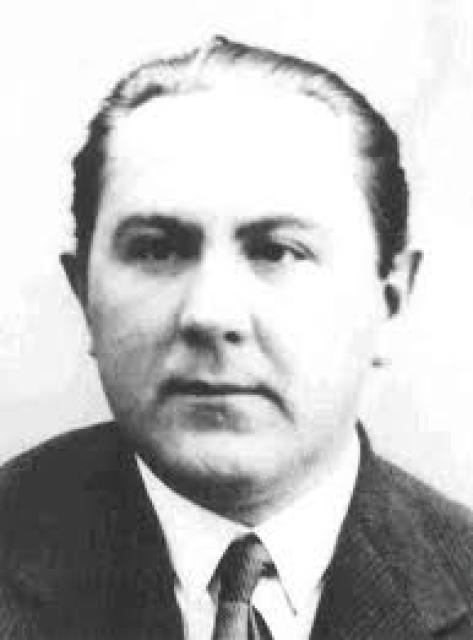
Vitezslav Nezval
 Czech
Czech- Early Life and Education
- Literary Beginnings
- The Avant-Garde Movement
- Surrealism and Communism
- Creative Work
- Post-War Engagement
- Recognition and Legacy
Early Life and Education
Vítězslav Nezval was born into a family of a teacher and a musician in the small town of Biskoupky in southern Moravia. At the age of seven, he was sent to a gymnasium in Třebíč, where he studied piano and music composition.
Literary Beginnings
From a young age, Nezval displayed a passion for writing. While still a teenager, he began to experiment with poetry, while also pursuing his interest in music. After the First World War, he moved to Prague and enrolled in the Faculty of Philosophy at Charles University, but did not complete his studies.
The Avant-Garde Movement
In 1921, Nezval joined the avant-garde literary-artistic group Devětsil and became a founder of the poetism movement. He played a significant role as one of the leaders of the Czech literary avant-garde.
Surrealism and Communism
In 1924, Nezval joined the Communist Party of Czechoslovakia (KSČ). He traveled to Paris, where he met André Breton and Paul Éluard, two leading figures of surrealism. In 1934, Nezval established a group of Czech surrealists in Prague, but disbanded it in 1938.
Creative Work
Nezval's work in the 1920s and 1930s was characterized by a search for new poetic forms and a gravitation towards realistic art. His poems and collections, such as "The Capricious Magician" (1922), "Pantomime" (1924), and "A Small Rose Garden" (1926), combined revolutionary themes with glimpses into the exotic and everyday aspects of life.
In the 1930s, Nezval's work became more political. His collections, including "Return Ticket" (1933), "With God and a Handkerchief" (1933), and "Prague with Fingers of Rain" (1936), celebrated his homeland, protested against the bourgeois order, and expressed hope for revolution.
During the Nazi occupation of Czechoslovakia, Nezval published patriotic works such as "Five Minutes from the City" (1939), the satirical poem "Prussians" (1939), and the epic poem "Historical Canvas" (1939).
Post-War Engagement
After the war, Nezval became actively involved in the social and cultural life of liberated Czechoslovakia. His work reflected the spiritual richness of the modern individual and the struggle for peace and socialism.
Recognition and Legacy
Vítězslav Nezval was a multifaceted artist who earned recognition as a poet, playwright, pantomime writer, composer, and painter. He translated works by renowned authors such as Arthur Rimbaud, Paul Éluard, Heinrich Heine, and Alexander Pushkin. Nezval was awarded the International Peace Prize and the title of "National Writer of the Czechoslovak Socialist Republic."


