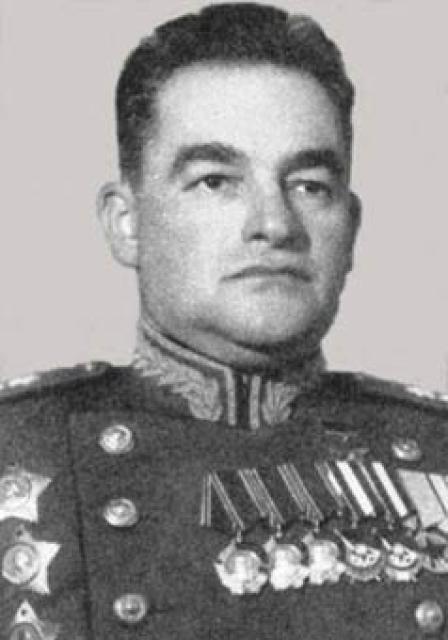
Vladimir Kolpakchi
- Early Life and Military Career
- Revolutionary and Civil War
- Interwar Years
- Spanish Civil War and World War II
- Command of Armies
- Post-War Career and Death
- Awards and Legacy
Early Life and Military Career
Vladimir Yakovlevich Kolpakchi was born on September 7, 1899, in Kiev. His ethnicity is disputed, with some sources claiming he was Russian while others suggest he was Jewish or Krymchak. Kolpakchi joined the Russian Army in 1916 and fought in World War I. He became a junior sergeant.
Revolutionary and Civil War
In 1917, Kolpakchi joined the Red Guard and participated in the storming of the Winter Palace. He officially joined the Red Army in 1918 and held various commands during the Civil War, including as a company, battalion, and regiment commander. He also served as the commandant of Petrograd.
Interwar Years
In 1923, Kolpakchi fought against the Basmachi Rebellion. From 1924 to 1936, he held positions such as regiment commander, chief of staff, and commander of a rifle division. He became deputy chief of staff of the Belarusian Military District and graduated from the Frunze Military Academy in 1928.
Spanish Civil War and World War II
In 1936, Kolpakchi was sent on a special mission to Spain. After returning in March 1938, he became commander of the 12th Rifle Corps. In December 1940, he was appointed chief of staff of the Kharkov Military District.
At the start of World War II, Kolpakchi was made chief of staff of the newly formed 18th Army. In the Donbas Defensive Operation, the 18th Army was surrounded. After the death of the army commander, Kolpakchi took command and led a portion of his forces out of the encirclement.
Command of Armies
In May 1942, Kolpakchi was appointed commander of the 7th Reserve Army. This army became the 62nd Army in July 1942 and participated in the Battle of Stalingrad. Kolpakchi commanded the 62nd Army until August 2.
Later in the war, Kolpakchi commanded the 30th Army in the Rzhev-Vyazma Offensive Operation and the 63rd Army in the Bryansk Offensive Operation. He also participated in the Kursk Offensive and the Orsha Offensive Operation. In February 1944, Kolpakchi became chief of staff of the 2nd Belorussian Front, and in April, he commanded the 69th Army of the 1st Belorussian Front.
Post-War Career and Death
After the war, Kolpakchi commanded the 40th Army, 1st Red Banner Army, and 6th Army. He also led the Northern Military District. In August 1956, he became the head of the Main Directorate of Combat Training of the Ground Forces.
On May 17, 1961, Kolpakchi died in an aviation disaster while flying in a Mil Mi helicopter. His death was blamed on the helicopter design, and his friend, Rodion Malinovsky, became biased against Mil's helicopters. Kolpakchi was buried in Novodevichy Cemetery in Moscow.
Awards and Legacy
Vladimir Kolpakchi was awarded the following:Hero of the Soviet Union
3 Orders of Lenin
3 Orders of the Red Banner
3 Orders of Suvorov, 1st class
2 Orders of Kutuzov, 1st class
Order of the Red Star
Other Soviet and foreign medals and orders
His daughter, Marina Kolpakchi-Kuznetsova, is married to the son of Admiral Nikolai Kuznetsov. His nephew, Yuri I. Sabry, is a prominent leader in the Krymchak community.




