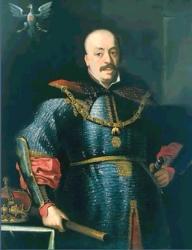
Vladislav IV Vaza
 Poland
Biography of Vladislas IV Vasa
Vladislas IV Vasa (9.6.1595 - 19.5.1648) was the King of Poland from 1632 to 1648. He was born in 1595 and in 1610, he was elected to the Moscow Tsardom but did not become the Tsar. On September 13, 1637, he married Cecilia Renata of Austria (1611-1644) and later, on March 10, 1646, he married Louise Maria Gonzaga (1611-1667).
After the death of Sigismund III, the Russian Tsar started a war against Poland in 1632-1634 but was defeated. In 1605, a messenger named Ivan Bezobrazov arrived in Krakow and informed Sigismund about the desire of the Moscow nobility to get rid of the impostor Dmitry and crown Prince Vladislas as the Russian Tsar. On February 4, 1610, the leaders of the Tushino camp signed a treaty with Sigismund to crown Vladislas as the Russian Tsar.
During the negotiations for the treaty, the main conditions were as follows: Vladislas would be crowned by the patriarch and the Orthodox clergy, he would respect and honor the churches, icons, and relics, and not interfere in church administration or seize the properties and income of monasteries and churches. He would not convert anyone to Catholicism and would not build Catholic or other non-Orthodox churches. He would not allow Jews to enter the state and would not change the old customs. All boyars and officials would be Russians, and all state affairs would be consulted with the boyar council and the zemsky assembly. The siege of Smolensk would be lifted and the troops would be withdrawn to Poland immediately. Sapega would be removed from the side of False Dmitry II, Marina Mniszech would return home and no longer be called the ruler of Moscow.
The treaty was signed on the way between Moscow and the Polish camp near Smolensk. After the oath of loyalty from the boyars and Zholtkevsky in accordance with the terms of the treaty, 10,000 people pledged their loyalty to Vladislas on the same day (August 17). The oath continued the next day in the Moscow Assumption Cathedral in the presence of Patriarch Hermogenes.
However, when Molchanov (the murderer of Boris Godunov's family) approached for the blessing, Hermogenes became upset and ordered him to be removed dishonorably from the church. Shortly after that, the Zaporozhian Cossacks, along with Lithuanians and Poles, began to capture the northern towns of Starodub, Pochep, Chernigov, Novgorod-Seversky, Mosalsk, and Belaya, forcing the residents to swear allegiance to the Polish prince. However, the residents, especially in Starodub and Pochep, fiercely resisted the invaders and set their cities on fire, sacrificing themselves by the thousands. The desperation was due to the cruelty of the Cossacks (Orthodox) and the Jolners (Catholics) towards the defeated, despite the prohibition of King Sigismund.
After the defeat of the army of Tsar Vasily Shuisky near Klushino, the Boyar Duma recognized Vladislas as the Tsar and sent an embassy for him on August 27. At first, his coronation did not take place due to Sigismund's desire to take the Russian throne himself, but later, thanks to the success of the Second People's Militia led by Dmitry Pozharsky and Kuzma Minin, the idea of transferring the throne to a non-believer prince was abandoned. In 1616, Prince Vladislas issued a circular letter to all residents of the Moscow state, reminding them how he was chosen for the Moscow throne supposedly "by the whole land". He accused Metropolitan Filaret of Rostov (who was still in Polish captivity) of defying the order given "by the whole land" and hypocritically expressed regret for the disasters that befell Russia, as if the Poles were not primarily responsible for these disasters. He declared that now, reaching maturity, he himself is going to conquer the Moscow throne given to him by God and urged the entire Moscow people to submit to him as the rightful ruler. He also promised to deal with Michael, Filaret's son, according to his royal mercy, at the request of the whole land. Vladislas' ambitions threatened a new civil war in Russia.
In 1618, Vladislas invaded the territory of the Moscow state and approached Moscow with an army led by the Crown Hetman Yakov Khotkevich. In August, hetman Zaporozhian Cossacks, Petro Konashevych-Sahaidachny, moved with a 20,000-strong army, which took several Russian cities on the way, setting them on fire and killing thousands of residents. On September 20, he joined Vasily Moskovsky in the Donskoy Monastery, where they fled because, according to the chronicler, "a great fear fell on them." On October 1, the siege of Moscow began by the forces of Vladislas and the hetman. "This war demanded the ultimate effort, and at the same time, the Moscow state had not yet recovered from previous disasters and was experiencing new ones of the same kind as in the previous years. Bandit gangs continued to roam and plunder the people; the conduct of the war with Vladislas increased the number of such enemies because the main forces of the Polish prince consisted of Cossacks and Lisovchiks [members of the band of deceased Polish colonel A. Lisovski], and both were waging war in a bandit way. Lithuanian people, along with Russian thieves, penetrated the banks of the Volga and Sheksna, and carried out robberies in these places. The cities were so poorly fortified and maintained that they could not serve as a reliable refuge for the people, who were unsafe to stay in their villages and villages. Meanwhile, the government was forced to collect special heavy taxes from the devastated people. These were requested money, imposed temporarily, due to the danger, which had to be paid by all according to their property and professions, and in addition, various bread requisitions for the maintenance of military personnel; finally, the people had to perform military service. The government ordered not to give any delays to the people and to rule mercilessly over money and supplies. Governors, carrying out such strict orders, collected individual and parish people, beat them from morning till evening; at night, the hungry and beaten were kept in prisons, and in the morning, they were brought out for beating, and many were beaten to death. The residents scattered, died of hunger and cold in the forests or fell into the hands of enemies and robbers. The disasters that the Russian people suffered this year from government officials were no easier than the non-military devastation. The monasteries, as before, enjoyed their privileges and, if not entirely exempted from assisting the common cause of defending the fatherland, participated much less in this matter; some of them received new privileged charters at that time. The military people reluctantly went to war; some did not show up at all, others ran away from the regiments: in the Novgorod land, the military people at that time had a special reason to be dissatisfied because the government took away their estates, distributed during the Swedish rule from the palace and black lands. The people were in such a state when Vladislas, going to Moscow in August 1618, again outraged the Russian people with his letter, assured that he would never plunder Orthodox churches or give out estates and lands to Polish people, that the Poles would not commit any violence or oppression against the Russian people; on the contrary, their previous rights and customs would be preserved. "You see," Vladislas wrote, "what devastation and oppression are being done to the Moscow state, not by us, but by the advisers of Michael, by their obstinacy, greed, and avarice, which we deeply regret: there will be nothing from us, your ruler, except for mercy, support, and care." His letters tempted only a few Russian people. However, as hard as it was for the Russian people to bear the rule of their government at that time, they knew the Poles too well, having come into contact with them during the Time of Troubles. Friendship with them was impossible. Vladislas' cause was definitively lost." According to the Polyanovsky Peace (1634), which ended the Polish-Russian war of 1632-1634, Vladislas IV Vasa finally abandoned his claim to the Russian throne. His rule was marked by the brutal suppression of the Cossack-peasant uprisings in 1637 and 1638 in Ukraine. Vladislas IV Vasa unsuccessfully sought to strengthen royal power, opposing the magnates. Shortly before his death, the national-liberation uprising of the Ukrainian people began under the leadership of Bohdan Khmelnytsky. Vladislas IV Vasa died on May 20, 1648, in the village of Mezhecha. There were rumors that he was poisoned. Since Vladislas IV Vasa did not leave any heirs, "interregnum" came again in the Polish-Lithuanian Commonwealth, and the Poles and Lithuanians faced difficult elections for a new ruler. Vladimir Boguslavsky