Vladislav Pytlyasinskiy
 Poland
- Biography of Vladislav Pytlyasinsky
- Becoming a World Champion
- Continuing his Career
- Anthropometric Data
- Honoring Pytlyasinsky's Legacy
Biography of Vladislav Pytlyasinsky
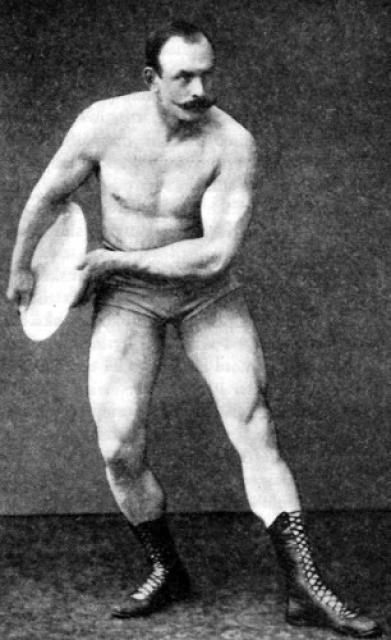
Vladislav Alexeevich Pytlyasinsky, an outstanding wrestler and athlete, world champion, and one of the founders of French wrestling in Russia, was born in Warsaw. He studied at a technical school and then, in 1882, went to Switzerland, where he acquired a degree in mechanical engineering and started working at a factory. During this time, he developed a passion for athletics and wrestling. He would visit the local athletic club three times a week, where he soon achieved remarkable results in weightlifting and wrestling. In 1885, he received his first prizes at competitions in Schaffhausen and Winterthur, Switzerland, and in 1886, he won the first prize, the "Honorary Wreath," at the international competition in Basel. In 1888, he won the second prize in Biel.
Becoming a World Champion
In late 1888, Pytlyasinsky traveled to Paris, where he defeated the famous Turkish wrestler Kara-Ahmet in just seven minutes. He also achieved victories over other well-known wrestlers. In November 1889, he faced off against the strongest German athlete and wrestler, Karl Abs, in Paris. Abs, a giant weighing seven poods, could lift a horse on his back and perform tricks with heavy weights and barbells. Abs challenged all amateur and professional wrestlers and offered 300 francs to anyone who could defeat him. Every evening, Abs easily defeated the challengers who accepted the world champion's challenge. And then, Pytlyasinsky accepted the challenge and stepped onto the mat. Thanks to his refined techniques and agility, Pytlyasinsky emerged victorious, becoming the first person to defeat Karl Abs. In Paris, Pytlyasinsky was awarded the title of world champion.
Continuing his Career
In 1890, Pytlyasinsky returned home, where he continued to engage in athletics and began teaching wrestling. In 1892, he started performing as an athlete alongside the famous strongman Emil Foss at the "Chinizzelli" circus in Warsaw. They demonstrated tricks with weights, lifted people on platforms, and performed exercises with Foss's famous barbell, which had such a thick grip that audience members couldn't even lift it off the platform. Pytlyasinsky continued to wrestle and achieved another victory over the renowned Georg Lurich, defeating him in just two minutes.
In 1896, Pytlyasinsky opened an athletics school in St. Petersburg, and later, in 1905, he opened another one in Odessa. In 1910, he organized the Athletic Institute in Odessa. His best student was Stanislaw Cyganiewicz-Zbyszko. In 1896, Pytlyasinsky published a textbook called "French Wrestling," which included 60 photographs of techniques demonstrated by the author and the well-known athlete Nikolai Ivanovich Kravchenko.
Anthropometric Data
Pytlyasinsky's anthropometric data, as of 1903, were as follows: height - 184 cm, weight - 105 kg, biceps - 44 cm, neck - 46 cm, chest circumference - 128 cm, thigh - 68 cm, calf - 44 cm.
Honoring Pytlyasinsky's Legacy
Competitions in classical wrestling are held in Warsaw in honor of Pytlyasinsky.