
Walter Raleigh
 Great Britain
- The Life of Sir Walter Raleigh
- A Chance Encounter
- The Rise to Favor
- A Love Affair
- The School of Night
- The Quest for El Dorado
- A Life of Adventure
- The Fall from Favor
- The Tower of Raleigh
- The Execution
- A Lasting Legacy
The Life of Sir Walter Raleigh
Sir Walter Raleigh was an English courtier, statesman, poet, writer, historian, and the favorite of Queen Elizabeth I. Born in a quiet London square over three hundred years ago, he was a source of both admiration and controversy. His birth is celebrated by his grateful followers, while his execution is mourned by his fervent opponents.

A Chance Encounter
On a snowy day in London, the procession of Queen Elizabeth I came to a halt as she hesitated to step into a muddy puddle. Sir Walter Raleigh, a young knight, emerged from the crowd and laid his crimson velvet cloak on the ground for the queen to walk on. Their eyes met, and Queen Elizabeth, with her piercing gaze and strong chin, noticed Raleigh's muscular legs, a sign of his endurance in love battles. She smiled slightly and regally passed by him, leaving his cloak trampled in the mud - a sacrifice he made for his fortune. This happened in 1581, when England was an ideal place for strong and daring young men wielding both the sword and the pen, seeking to conquer their age. Raleigh was one of them, although he and those around him were not aware of it yet.
The Rise to Favor
In one of the London theaters, a young actor named Shakespeare was beginning his career. In a tavern called "The Boar's Head," a scandalous man named Marlowe could often be heard causing a commotion. At that time, no one could have guessed that these men would become great figures of English literature. Raleigh, on the other hand, firmly grasped his fortune, which elevated him to the highest ranks of society. Queen Elizabeth, a wise woman who saw through people, took notice of the young officer who arrived with a report from rebellious Ireland. His speech and manners appealed to the virgin queen. Raleigh remained at court and soon even the gentlemen of the court respectfully removed their hats before him. He was granted a wine monopoly, which meant he no longer had to worry about how to pay for his meals. Along with wealth came honor. In the throne room, Raleigh kneeled, and Queen Elizabeth tapped his shoulder with a naked blade, symbolically raising him as a knight. Now, he would ride alongside her on royal hunts, beheading deer at the monarch's command.
A Love Affair
To love the queen was an art of its own. Excessive persistence could be met with punishment, while shyness could result in banishment from the court. The life and death of Walter Raleigh were now in the hands of Queen Elizabeth. He had to wait for the slightest nod, gesture, or smile from her. Finally, she made up her mind and whispered, with a husky voice, "Stay here, Sir Walter." And then... the fastenings of her golden dress rustled, her gaze became hazy, her lips parted, and the queen fell into the arms of Sir Walter. Shortly after, Raleigh obtained the monopoly on tin and became the captain of the royal guard. He settled in a magnificent mansion granted by the Crown. But even the ladies-in-waiting didn't know when he managed to make his way into the queen's bedchamber.
The School of Night
Raleigh's interests extended beyond courtly life. In his London home, a circle called the "School of Night" gathered. Well-meaning Londoners feared the members of this society and called them atheists. Christopher Marlowe, Thomas Harriot, and George Chapman recited poetry, criticized the Bible, and debated the creation of the world. Lawrence Kemys, also a member of the group, was not unfamiliar with poetry, but he was more attracted to the sword. Within a few days, Raleigh and Kemys would board a ship armed with heavy cannons and set sail in search of the legendary city of El Dorado, where houses were made of gold, roads were paved with silver, and people lived without worry or sorrow.
The Quest for El Dorado
Raleigh sought El Dorado in South America. His expedition traveled 450 kilometers along the Orinoco River, losing many men along the way. However, El Dorado remained elusive. Although Raleigh brought back a significant amount of gold to England and established a colony on Roanoke Island, when he returned twenty years later, the colonists had disappeared without a trace. Blonde-haired, blue-eyed natives still lived on Roanoke, but the fate of their ancestors remained a mystery.
A Life of Adventure
Sir Walter Raleigh disappeared for a long time, chasing fame. In the New World, he founded the first English colony, which he named Virginia in honor of his virgin queen. From there, he brought tobacco back to Europe and introduced pipe smoking, which soon became popular. Meanwhile, Queen Elizabeth underwent significant changes.
The Fall from Favor
Robert Devereux, the second Earl of Essex, emerged at court as the new favorite of Queen Elizabeth. Charming and audacious, Essex became the queen's new confidant. Raleigh, now retired in Kilcolman Castle, could focus on his studies and poetry. However, Essex insulted the queen by marrying a woman of his own choosing and paid for it with his life. Raleigh, rejected once again, returned to the palace, but his troubles were far from over. He was accused of treason, plotting to put another monarch on the throne. Despite the pleas of some jurors who were moved by Raleigh's courageous behavior during the trial and begged for his life, he was sentenced to be drawn and quartered. However, his sentence was later commuted to beheading.
The Tower of Raleigh
Sir Walter Raleigh spent many years as a prisoner in the Tower of London, which is now known as the "Tower of Raleigh." It was here that he wrote sonnets, composed his famous "History of the World," and even gave lessons to Prince Henry. Raleigh, condemned to death, became the tutor of the future heir to the throne. King James I sought Raleigh's advice on several occasions, including when choosing a suitor for his daughter Elizabeth. Raleigh advised against an Italian suitor and suggested finding a husband from Germany, which aligned with England's interests. While King James followed his advice, he did not spare Raleigh's life – the king was true to himself. He feared conspirators, disliked intellectuals, and hated tobacco, which was increasingly popular due to Sir Walter Raleigh's influence.
The Execution
Raleigh did not fear death. As the years passed, his hair turned silver, and he often dreamed of the happy land of El Dorado at night. Once again, he set sail in search of the blessed country, and his loyal companion Lawrence Kemys captured and looted a small Spanish town. The Spanish ambassador demanded retribution from Queen Elizabeth. When the 66-year-old Sir Walter Raleigh laid his head on the executioner's block, he smiled and boldly proclaimed, "No matter, as long as the soul is turned right." These were his final words. The sharp axe gleamed in the sunlight, a loud thud echoed, thousands of lights flickered in his eyes, and it was all over. Raleigh's body was put on display for the crowd's entertainment.
A Lasting Legacy
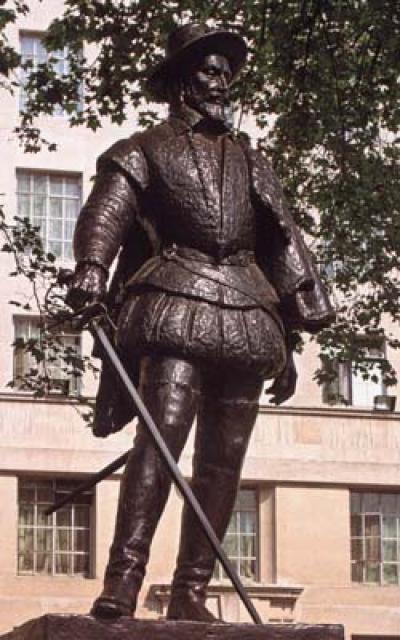
Twice a year, the quiet London square thrives with passions, while the bronze statue of Sir Walter Raleigh silently watches the heated debates between smokers and non-smokers. Perhaps he recalls the verses "Of the Soul's Saving Benefit of Tobacco," which infuriated King James, who attributed them to Raleigh, an atheist and freethinker:
"Look upon the smoke, ascending high,
And view the emptiness of worldly things.
The world with beauty is but empty smoke.
Smoke tobacco and think..."
When Sir Walter Raleigh was executed, the Tower of London was still called the "Tower of Raleigh." Here, Raleigh wrote poetry and his renowned "History of the World." He even gave lessons to Prince Henry while being sentenced to death. Raleigh's life and death were intertwined with the monarchies of Queen Elizabeth and King James. And while his body was laid to rest, the memory of his adventures and contributions to England's history lived on.


