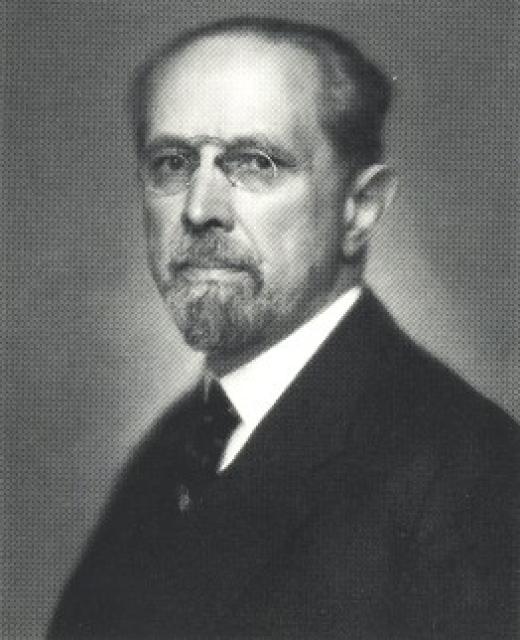
Werner Sombart
 Germany
- Biography of Werner Sombart
- Ideas and Influence
- Conservative Revolution and Conflicts
- Werner Sombart passed away on May 18, 1941 in Berlin.
Biography of Werner Sombart
Werner Sombart (1863–1941) was a German economist, sociologist, and philosopher. He was born on January 19, 1863 in Emsleben, Prussia. Sombart served as a professor of economics in Breslau and Berlin. He was one of the first German sociologists and, along with Max Weber, co-directed the journal "Archiv fur Sozialwissenschaft und Sozialpolitik." In the 1920s, he became the first president of the German Sociological Society.
Ideas and Influence
Sombart developed the ideas of the "historical school" in political economy and was influenced by Marxism, aligning himself with "chair socialism." His work "Modern Capitalism" (1902) brought him widespread recognition. In this book, as well as in his subsequent works on the emergence of capitalism, Sombart highlighted the connection between the economy and various social institutions and historical circumstances.
Sombart engaged in a debate with Max Weber, arguing against Weber's claim that capitalism originated from Protestant ethics. Instead, Sombart linked the genesis of capitalism to multiple social and psychological factors. He explored topics such as the involvement of Jews in the formation of modern economy and the relationship between war and capitalism.
During World War I, Sombart shifted towards German nationalism. In his book "Merchants and Heroes" (1915), he contrasted the "heroism" of Germans with the utilitarianism of the English. In the 1920s, he completely distanced himself from Marxism and developed one of the earliest versions of "understanding sociology," which he later applied to political economy in his work "The Three National Economies" (1930).
Conservative Revolution and Conflicts
As one of the leading figures of the "conservative revolution," Sombart further developed the ideas of a unique "German socialism" in the early 1930s. This ideology aimed to overcome both liberal capitalism and Marxist socialism. In 1938, he published his major philosophical work "On Man," in which he developed the ideas of Wilhelm von Humboldt, Wilhelm Dilthey, and the entire "historical school" regarding man as the creator and creation of culture.
The publication of this book, which saw Sombart returning from nationalism to the ideals of humanism, led to a conflict with the ideologues of National Socialism. His work aligned closely with the ideas of "cultural anthropology" proposed by Ernst Rothacker and Martin Landmann.


