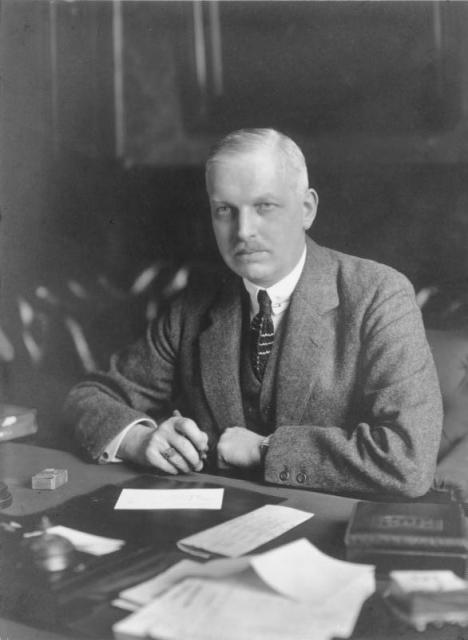
Wilhelm Cuno
 Germany
- Early Life and Education
- Government Service and HAPAG
- Post-War Reconstruction
- Reich Chancellor
- Post-Government Career
- Political Views and Legacy
Early Life and Education
Wilhelm Cuno, a German entrepreneur, was born on July 2, 1876, in Hagenow, Germany, to a civil servant father. He studied law at the Universities of Berlin and Heidelberg and served in several regional courts. In 1900, he obtained a doctorate of law from the University of Breslau.
Government Service and HAPAG
After graduating, Cuno entered the Prussian civil service in 1907. In 1917, he became the General Secretary of the Imperial Treasury, where he gained the attention of Albert Ballin, the General Director of the Hamburg America Line (HAPAG). In 1918, Ballin appointed Cuno as a Director of HAPAG.
Post-War Reconstruction
With the end of World War I, Germany's shipping industry faced significant challenges. Cuno played a key role in rebuilding HAPAG, securing a collaboration agreement with United American Lines in 1920. He also participated in the Paris Peace Conference and the 1922 Genoa Conference as an economic expert.
Reich Chancellor
In November 1922, Cuno was appointed Chancellor by President Friedrich Ebert. As the leader of a minority government, he sought to address the economic crisis and resolve the reparations issue. However, his attempts to resist the French and Belgian occupation of the Ruhr in 1923 failed, leading to hyperinflation and the collapse of his government in August 1923.
Post-Government Career
After his resignation, Cuno remained on HAPAG's supervisory board. He played an active role in German-American relations and founded the first Rotary Club in Germany in 1927. In 1930, he brokered a partnership agreement between HAPAG and Norddeutscher Lloyd.
Political Views and Legacy
Cuno was a political Independent who supported value conservatism and a liberal economic approach. He declined to rejoin the German People's Party and opposed the appointment of Adolf Hitler as Chancellor. Despite his brief tenure as Chancellor, Cuno made a significant contribution to German post-war economic and political life. He died on January 3, 1933, at the age of 56.