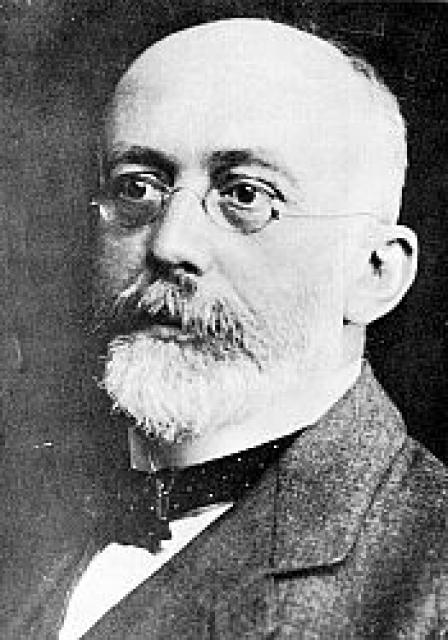
Wilhelm Weinberg
 Germany
- Biography of Wilhelm Weinberg
- Contributions to Genetics and Epidemiology
- The Hardy-Weinberg Law
- Later Years and Legacy
Biography of Wilhelm Weinberg
Wilhelm Weinberg was a German doctor born in Stuttgart into a Jewish family. He studied medicine in Tübingen and Munich, earning his medical degree in 1886. After completing his studies, he returned to Stuttgart in 1889, where he established a successful general practice as well as specializing in obstetrics and gynecology.
Contributions to Genetics and Epidemiology
In addition to his medical practice, Weinberg had a keen interest in theoretical questions and founded the German Society for Genetics and Eugenics, serving as its president. He dedicated a significant part of his life to studying medical statistics and human genetics, including the study of twins, mutations, and the application of inheritance laws to populations.
The Hardy-Weinberg Law
In 1908, independently from the English mathematician Godfrey Hardy, Weinberg formulated a generalization known as the Hardy-Weinberg Law. This law describes the frequencies of different genetic variations in a population under certain assumptions.
Later Years and Legacy
A few years before his death, Weinberg retired from his medical practice and moved to Tübingen, where he passed away. His works on genetics and epidemiology were initially published in German and only gained widespread recognition beyond the German-speaking world after his death.
Overall, Wilhelm Weinberg was a notable German doctor and geneticist who made significant contributions to the field of genetics and epidemiology. Through his research and leadership, he left a lasting impact on the understanding of inheritance and population genetics.


