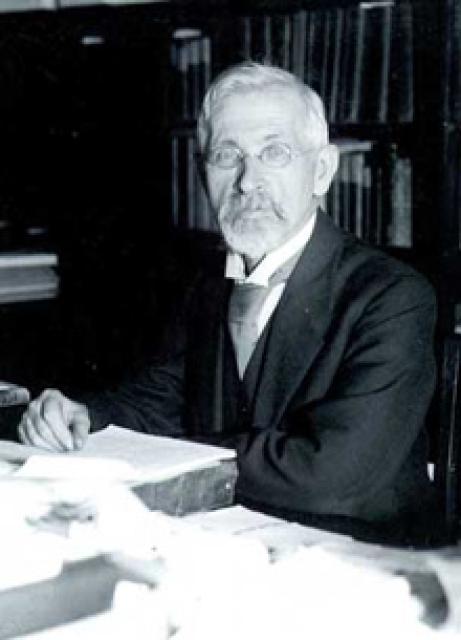
William Alexander Craigie
 Great Britain
- Early life and a fascination with language
- An editor of the Oxford English Dictionary
- Building dictionaries across continents
- A scholarly partnership and later years
Sir William Alexander Craigie was a Scottish lexicographer and philologist whose work helped shape three landmark reference projects: the Oxford English Dictionary, A Dictionary of American English, and A Dictionary of the Older Scottish Tongue. A scholar of Scots and Scandinavian languages, he combined meticulous historical research with an extraordinary appetite for words, beginning his own collecting work as a schoolboy and continuing to edit dictionaries into old age.
Early life and a fascination with language
Craigie was born in Dundee on August 13, 1867, the youngest son of James Craigie, a gardener, and Christina Gow. He grew up speaking Lowland Scots and learned some Gaelic from family members. As a child he became interested in Scotland’s early writers and language, and at around 13 he began annotating a copy of John Jamieson’s Scottish dictionary.
He attended St Andrews University, graduating with honours in classics and philosophy in 1888. There he developed a strong foundation in philology and began learning German, French, Danish, and Icelandic. His research on manuscripts of Wyntoun’s Chronicle helped clarify how different versions of the early Scots text were related. After further study at Oxford and time in Copenhagen, he returned to St Andrews as a lecturer, with a particular interest in Scandinavian language and literature.
An editor of the Oxford English Dictionary
In 1897, Craigie was invited to join the editorial staff of the New English Dictionary, the work that became the Oxford English Dictionary. He began with the letter G and went on to edit a substantial portion of the dictionary. In 1901 he became one of its principal editors, alongside James Murray and Henry Bradley, and after Bradley’s death in 1925 he took over the senior editorship.
The OED was completed in 1928, after decades of work by editors, readers, and volunteer contributors. Craigie also helped prepare its first supplement, published in 1933. Alongside this enormous editorial responsibility, he held academic posts at Oxford: he lectured in Scandinavian languages and became Rawlinson and Bosworth Professor of Anglo-Saxon in 1916. He was knighted in 1928 in recognition of his scholarship.
Building dictionaries across continents
In 1925 Craigie moved to the University of Chicago, where he became professor of English and led work on A Dictionary of American English. The project documented American words and meanings through historical evidence, giving the history of U.S. English its own comprehensive reference work. It was published in four volumes between 1936 and 1944.
He also established the framework for A Dictionary of the Older Scottish Tongue, a historical record of Older Scots from its earliest written evidence through the end of the seventeenth century. Craigie edited the first two volumes, published during his lifetime; the long project continued after his death and was completed decades later. His work in this field formed a foundation for today’s Dictionary of the Scots Language.
A scholarly partnership and later years
Craigie married Jessie Kinmond Hutchen in 1897. They had no children, and she became an important collaborator in his literary and lexicographical work, including contributing translations to the Oxford edition of Hans Christian Andersen’s fairy tales. The couple shared interests in languages and traveled widely, while Craigie maintained a disciplined routine that allowed him to pursue research well beyond his formal academic duties.
He retired from the University of Chicago in 1936 and returned to England, settling in Watlington, Oxfordshire. He continued to work on the Older Scottish Tongue dictionary and advised Oxford University Press on the future of the OED. Craigie died on September 2, 1957, aged 90.
His contribution reaches beyond the dictionaries that bear his editorial imprint. By insisting that words be documented through historical evidence and by pursuing the history of Scottish, American, and Scandinavian language with equal curiosity, he helped expand lexicography into a broader study of culture and time.


