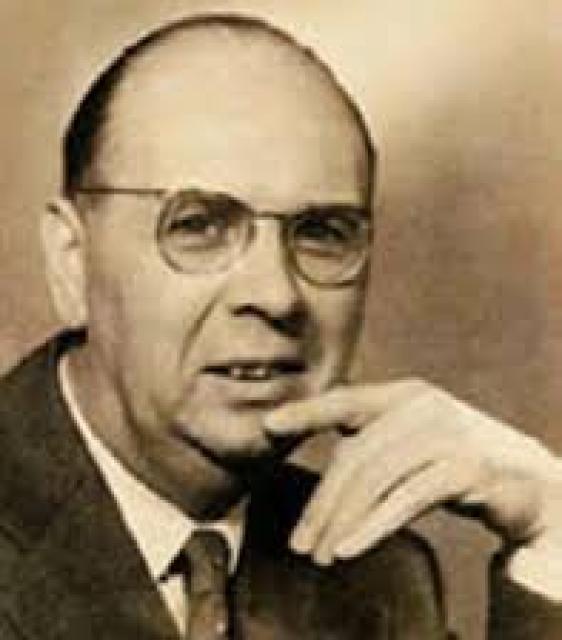
Gaston Waringhien
 France
- Early Life and Education
- Language Teaching and Scholarship
- Involvement with Esperanto
- Lexicographical Masterpieces
- Plena Gramatiko and Linguistic Research
- Later Career and Legacy
Early Life and Education
Gaston Waringeon was born on July 20, 1901, in Lille, France. His father was a foreign language teacher. Waringeon displayed academic prowess from a young age, earning a bachelor's degree in literature at 19 and a master's degree in philology at 22.
Language Teaching and Scholarship
Waringeon went on to teach language and literature at various schools and lycées in Lille, Tours, and Paris. He developed a strong reputation in French lexicology, collaborating with the Larousse lexicography group.
Involvement with Esperanto
Waringeon encountered Esperanto in 1916 and became a member of the Language Committee (predecessor to the Esperanto Academy) at 24. He played a pivotal role in the Esperanto movement as a notable linguist, author and co-author of authoritative dictionaries, prolific publicist, talented translator, and poet.
Lexicographical Masterpieces
Waringeon's experience with the Plena vortaro proved invaluable when he independently prepared the Supplement to the Complete Dictionary (1954) and worked on the Large Esperanto-French Dictionary (1957), which became the definitive work of its kind until the late 1980s.
In 1960, Waringeon embarked on his lexicographical masterpiece: the Complete Illustrated Dictionary of Esperanto (PIV), which comprised 3,285 pages in its final form. Published in 1970, the PIV quickly became the most authoritative Esperanto dictionary. A supplement was published in 1987, and work began in 1990 on its successor, the New Complete Illustrated Dictionary of Esperanto (NPIV), published in 2002.
Plena Gramatiko and Linguistic Research
Waringeon also excelled in Esperanto grammar. With Hungarian Esperantist Kálmán Kalocsay, he co-authored the Plena gramatiko (1935), the most comprehensive and detailed grammar of Esperanto at the time. Waringeon's contributions significantly expanded the Esperanto linguistic terminology used in the work.
Later Career and Legacy
Waringeon retired in 1963 and continued to contribute to the Esperanto community until his death. Despite some criticism, his Plena analiza gramatiko (PAG), published in its final edition in 1985, remains the most authoritative reference on Esperanto grammar and word formation. Gaston Waringeon's work has left an enduring legacy in the world of Esperanto, establishing him as an eminent Esperantist and a significant figure in language scholarship.


