William Brui
 France
- Soviet and French Artist
- Early Interest in Art
- Work at the Experimental Workshop
- Exhibitions and Artistic Development
- Later Career and Exhibitions
- Artistic Style and Works
Soviet and French Artist
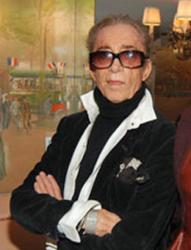
William Bruy was a Soviet and French artist and a prominent figure in the second Russian avant-garde movement. His mother, Dora Rafailovna Friedman, came from a Jewish family. Her father, Rafail Markovich Friedman, was one of the early emigrants who left the USSR for Israel in the late 1950s. He was a rabbi and a descendant of a prominent figure in the Chabad-Lubavitch movement. William's father, Petr Vasilievich, had a Belarusian surname Bruy.
Early Interest in Art
William Bruy showed a passion for visual arts from a young age. While visiting the Hermitage library, he became familiar with publications on the Russian avant-garde of the early 20th century.
Work at the Experimental Workshop
In 1962, William Bruy started working as a printer at the Experimental Workshop of the Leningrad Union of Artists. There, he met students of Malevich, Filonov, Matyushin, and other innovators of the 1910s and 1920s, such as Alexander Vedernikov, Vera Matyukh, Gerda Nemenova, Evgeniya Magaril, and Anatoly Kaplan.
Exhibitions and Artistic Development
From 1965 to 1970, William Bruy exhibited at the semi-official Lavka Khudozhnikov gallery and in group exhibitions of Leningrad artists. In 1970, he moved to Israel to live with his grandfather in the strictly religious community of Kfar Chabad. However, Bruy struggled to reconcile his artistic nature with the religious life and found it difficult to express his creative potential within that context. In 1971, he relocated to Paris, where he met Alexander Liberman, the artistic director of Vogue magazine. Liberman showed interest in Bruy's work and provided him with his own studio in New York. Bruy worked there in 1973, 1975, and 1978 on a series of large-scale canvases titled "Unified Fields."
Later Career and Exhibitions
Starting from 2005, William Bruy organized exhibitions at the commercial gallery Atelier-2 in the prestigious Winzavod complex in Moscow and other Moscow galleries. His exhibition at the State Russian Museum in St. Petersburg in July-August 2009 attracted a significant number of visitors and media attention. He was interviewed on Russian radio and television.
Artistic Style and Works
William Bruy's early works from 1960-66 were figurative in nature, including oil paintings, drawings, and engravings. As his career progressed, he ventured into abstraction, pushing the boundaries of his art. In 1969, he self-printed a book titled "Ex Adverso" on an etching press he built himself. The book featured variations of elementary geometric forms, with a dense cross-hatching technique that he later incorporated into his large-scale paintings in the United States.
In France and the US, Bruy continued to develop his unique style. While his works from the 1970s could be classified as minimalism, his later pieces increasingly incorporated spontaneous brushstrokes, drips, and splatters, reminiscent of abstract expressionism. One notable series is "Etrous" (1986-1990), consisting of canvases and lithographs. In his "Temple" series, the initial impression of the outlines of a destroyed temple emerges as echoes of cosmic visions inspired by the Suprematist school of Malevich. After a few relatively unproductive years, Bruy embarked on a new series called "Matter-Creatures." These canvases contain two layers: the underlying organizational structure features images from the artist's previous periods, while the surface is composed of flowing patches of paint, resembling spontaneously formed biological forms. At times, this biomorphic layer recedes into the background, giving way to confident geometric gestures.