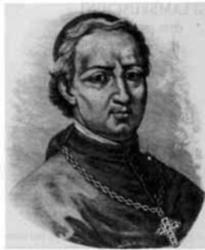
William Fleetwood
 Great Britain
- Early Life and Education
- Ecclesiastical Career
- The Bishop's Reputation
- Royal Favor and Political Opposition
- Literary Works
- The Chronicon Preciosum
- Legacy in Economics
Early Life and Education
William Fleetwood was born in the Tower of London on January 1, 1656, into an ancient Lancashire family. He received his education at Eton College and King's College, Cambridge.
Ecclesiastical Career
During the Glorious Revolution, Fleetwood entered the clergy and was soon appointed rector of St Austin, London, and lecturer at St Dunstan in the West. In 1702, he became a canon of Windsor and in 1708 was consecrated as Bishop of St Asaph. In 1714, he was translated to the See of Ely, where he died on August 4, 1723.
The Bishop's Reputation
Fleetwood was widely regarded as one of the finest preachers of his time, known for his diligent preparation and effective delivery. He was also a man of high character and integrity, respected by both contemporaries and posterity. As a bishop, he was an able administrator, excelling most of his peers.
Royal Favor and Political Opposition
Fleetwood was a favorite of Queen Anne despite his Whig principles. However, his opposition to the doctrines of non-resistance and passive obedience brought him into conflict with the Tory ministry in 1712 and with Jonathan Swift, although Fleetwood himself never descended into personal attacks.
Literary Works
Fleetwood's major works included "An Essay on Miracles," "Chronicum Preciosum," and "Free Sermons," the latter of which included his funeral sermon for Queen Mary. He was married twice, first to Frances Smith and later to Mary, the daughter of Sir John Coke and widow of Sir Edward Hartopp. A collection of his sermons with a biographical preface was published in 1737.
The Chronicon Preciosum
In his anonymously published "Chronicon Preciosum," Fleetwood calculated average price levels for various commodities and services, using a baseline of £5. Based on the idea that an Oxford college fellow lost his fellowship if his income exceeded £5 in 1440, Fleetwood illustrated the changing purchasing power of bread, ale, meat, clothing, and books over time. His tables of price changes for various commodities suggested a relatively constant rate of inflation, leading him to conclude that £5 in the 15th century was equivalent to £28-30 in the early 18th century.
Legacy in Economics
Adam Smith used some of Fleetwood's data in the first edition of "The Wealth of Nations" (1776), but did not fully appreciate the concept of comparing the purchasing power of money over time. Recognition of the economic significance of Fleetwood's work came only in the 19th century. Francis Ysidro Edgeworth called "Chronicon Preciosum" "the earliest and one of the best scientific treatises on index numbers." Fleetwood's sermons have also been analyzed as valuable economic texts.