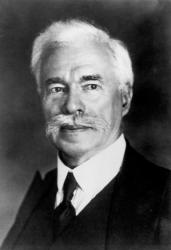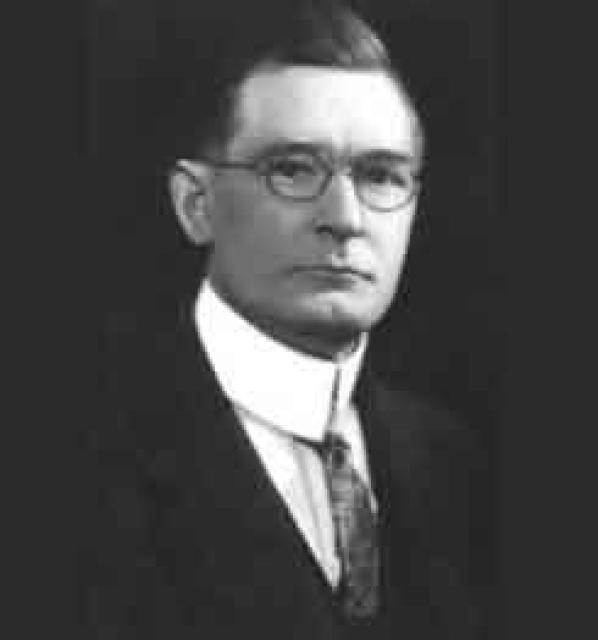
William Gann
 USA
USABiography of William Gann
William Delbert Gann was a financier, broker, and author of a series of well-known techniques and tools in technical analysis. He developed his techniques based on the laws of geometry, astronomy, and astrology, which drew both criticism and popularity in the financial world. He also gained fame as the author of several books on brokerage.
Gann was born on June 6, 1878, in Lufkin, Texas. His father was a cotton farmer. At the age of 24, Gann became a broker in 1902, a somewhat unusual profession for someone known for his deep religious beliefs. Despite his religious devotion, Gann believed in the scientific value of the Bible and regarded it as the greatest book ever written. These complex views of the world were also evident in Gann's own work. He was known to be a Mason, which explained his profound knowledge of ancient mathematical methods and techniques, which he learned by studying ancient Egyptian and Greek cultures.
One of Gann's most famous developments was the "Gann angles," which he described in his book "The Basis of My Forecasting Method" published in 1935. Calculating the Gann angle was essentially equivalent to finding the derivative of a given line on a graph, although it had noticeable simplicity.
Gann analyzed daily, monthly, and weekly price peaks and constructed his "angles" based on his calculations and existing charts. According to Gann, as long as the price rises, remaining above the ascending angle (and never falling below it), the market is strong. On the contrary, if the price falls below the descending angle, the market is weak. The level of "strength" or "weakness" of the market could be further analyzed based on the values of the angles themselves. Each geometric angle, as a line extending to infinity, divided time and prices on the graph into proportional parts. The most important angle, according to Gann, was the "1x1 angle" - a 45-degree angle representing 1 unit of price to 1 unit of time.
The effectiveness of Gann's angles in practice is still not entirely clear. Gann himself claimed to have used his technique quite actively and made good profits using it. Indeed, he was able to make several accurate forecasts. It is believed that he predicted the market situation (the peak of a bullish market) in the autumn of 1929 as early as 1928.
Critics pointed out that Gann's theories sometimes lacked a scientific basis. For example, the financialist claimed that his schemes could be easily scaled as needed, which made previous forecasts irrelevant. The lack of clear recommendations in several key areas and his adherence to "financial astrology" methods led many critics to consider Gann's theories unscientific and unworthy of serious consideration. However, Gann did not lack supporters.
Gann was married three times during his life, and he had four children from his first two marriages. In 1954, he suffered a heart attack, and his health began to deteriorate. In 1955, after a trip to Cuba, Gann returned in a weak condition and was admitted to the hospital. On June 18, 1955, at the age of 77, the financier passed away. He was buried in a Masonic cemetery in Brooklyn.