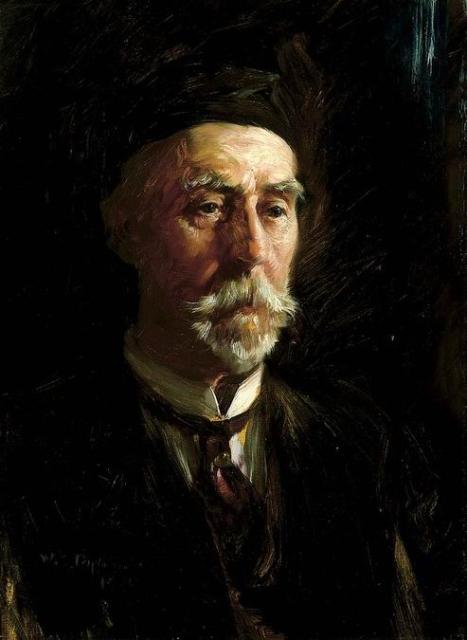
William Holmes
 USA
USA- William Henry Holmes: A Pioneer in American Anthropology and Art
- Geological and Archaeological Explorations
- Field Museum and the University of Chicago
- The National Gallery of Art
- Later Years and Legacy
William Henry Holmes: A Pioneer in American Anthropology and Art
Early Life and EducationWilliam Henry Holmes was born near Cadiz, Ohio, on December 1, 1846. Initially aspiring to become a teacher, his interest in art and science led him into the fields of graphic arts and archaeology.
Geological and Archaeological Explorations
From 1872 to 1889, Holmes worked in various capacities for the United States Geological Survey, conducting explorations in the western states. He continued to serve the government for much of his life, holding positions such as Curator of Anthropology at the National Museum (1897-1902; 1910-1920), and Chief of the Bureau of American Ethnology (1902-1909).
Field Museum and the University of Chicago
In the years 1894-1897, Holmes served as Curator of Anthropology at the Field Museum (Chicago) and as Professor of Geology at the University of Chicago. During this time, he played a significant role in the debate surrounding the potential correlations between American and European archaeological sequences.
The National Gallery of Art
From 1920 to 1932, Holmes served as the Director of the National Gallery of Art. He was deeply interested in the artistic aspects of the ancient cultures he studied, and many of his publications featured exquisite illustrations. Notable works include "Art in Shell of the Ancient Americans" (1883), "Ancient Art of the Province of Chiriqui, Colombia" (1888), and "Archeological Studies Among the Ancient Cities of Mexico" (1895-1897).
Later Years and Legacy
Holmes retired to Royal Oak, Michigan, where he passed away on April 20, 1933, as President of the American Anthropological Association. His contributions to the fields of anthropology and art history continue to be recognized and appreciated.


