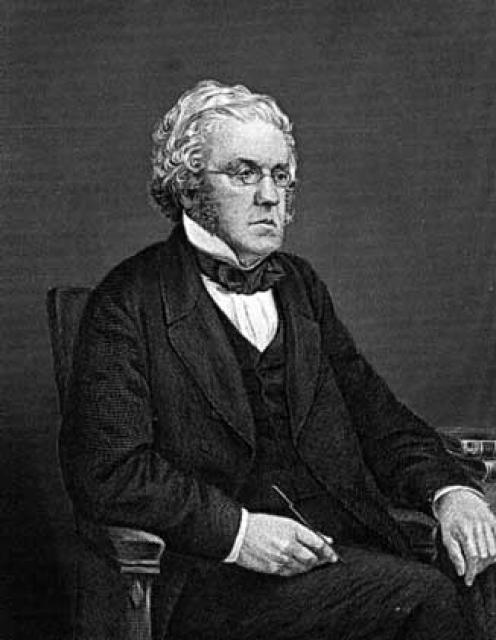
William Makepeace Thackeray
 Great Britain
- William Makepeace Thackeray
- Artistic and Literary Beginnings
- Periodical Contributions and Literary Parodies
- Family Life and Personal Loss
- Literary Breakthrough: "Vanity Fair"
- Other Major Works
- Later Career and Unfinished Masterpiece
- Social Commentary and Legacy
William Makepeace Thackeray
Early Life and EducationBorn into an affluent family, William Makepeace Thackeray was sent to London for his education at the tender age of six. He attended private schools and later enrolled at Charterhouse School from 1822 to 1828. Upon his mother's relocation to London following her remarriage, Thackeray entered Trinity College, Cambridge University. However, his university years were marred by financial setbacks and gambling losses, including the loss of his inheritance.
Artistic and Literary Beginnings
Faced with financial difficulties, Thackeray pursued art and painting. He studied drawing in Paris and later illustrated his own works. In 1836, he briefly considered joining forces with Charles Dickens, who was seeking an illustrator for his "Pickwick Papers." However, it was not until his marriage to Isabella Shaw in the same year that he seriously turned to writing.
Periodical Contributions and Literary Parodies
Thackeray's early literary endeavors often appeared under pseudonyms in leading periodicals of the time. His series of literary parodies, "Novels by Eminent Hands" (1839-1847), showcased his discerning taste and impeccable style. Thackeray's fondness for the Enlightenment era, particularly the works of Henry Fielding and Tobias Smollett, influenced his literary output. He penned a satirical parody titled "Rebecca and Rowena" (1850), a burlesque ending of Walter Scott's "Ivanhoe" that criticized its romanticizing of the Middle Ages.
Family Life and Personal Loss
Thackeray's personal life was marked by both joy and sorrow. He had three daughters, but his wife's developing mental illness forced them apart. Thackeray resumed bachelorhood, entrusting his daughters' care to their mother and stepfather. In 1846, he purchased a home and reunited with his children.
Literary Breakthrough: "Vanity Fair"
Thackeray achieved fame and financial success with the publication of "Vanity Fair" (1847-1848). The novel follows the intertwined lives of two contrasting characters, Becky Sharp and Amelia Sedley, against the backdrop of the post-Napoleonic era. Thackeray's compelling characters and sharp social satire resonated with the public, establishing his reputation as a master storyteller.
Other Major Works
Thackeray's other notable novels include "Pendennis" (1848-1850), "The History of Henry Esmond" (1852), "The Newcomes" (1853-1855), "The Virginians" (1857-1859), and "The Adventures of Philip" (1861-1862). He also published Christmas books, wrote poetry and ballads, and delivered lectures both in England and America.
Later Career and Unfinished Masterpiece
In 1860, Thackeray became the editor of the "Cornhill" magazine. During this time, he published "Lovel the Widower" (1860) and the insightful "Roundabout Papers" (1860-1863). He left the magazine two years later to focus on his final novel, "Denis Duval" (1864). Tragically, Thackeray died before completing it.
Social Commentary and Legacy
Thackeray's writings provide a comprehensive portrayal of human nature. His focus on upper-class society and individuals who sought social advancement through questionable means reflects Victorian prejudices. Yet, he also criticized hypocrisy and moral turpitude. Thackeray's innovative narrative techniques, such as the use of a narrator as a "showman," enriched the art of storytelling and continues to influence literature today.


