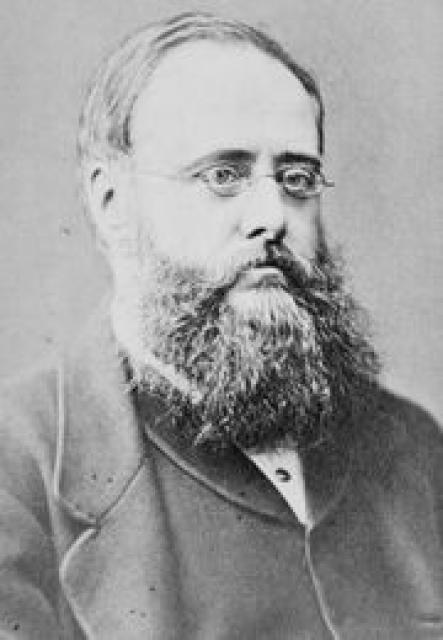
William Wilkie Collins
 Great Britain
- Biography of Wilkie Collins
- Early Works and Friendship with Charles Dickens
- Success as a Writer
- Later Works and Criticism
Biography of Wilkie Collins
William Wilkie Collins was an English writer, known for being the author of one of the first and most successful detective novels, "The Moonstone". He was born on January 8, 1824 in London. Collins attended a private school and later traveled throughout Europe, living in Italy. He also worked for a tea importing firm for a period of time. In 1847, he decided to pursue a career in law and enrolled at Lincoln's Inn, becoming a barrister in 1851.
Early Works and Friendship with Charles Dickens
In 1848, Collins published his first book, a memoir about his father who was a well-known artist and a strict moralist who instilled a love for art in his sons. His first novel, "Antonina" (1850), holds less interest today than "Rambles Beyond Railways" (1851), which is a collection of travel notes about his journey through Cornwall. In 1851, Collins became friends with Charles Dickens, a friendship that lasted for many years. During the 1850s, he also formed a close relationship with Caroline Elizabeth Graves, who had a strong influence on him. According to artist J.E. Millais, their first meeting likely inspired the scene for "The Woman in White" (1860), considered to be his best book. However, the novel is undoubtedly based on a case from French legal practice.
Success as a Writer
Collins achieved great success with his novel "The Moonstone" (1868), one of the first detective fiction novels with a skillfully constructed plot. The story revolves around the mysterious disappearance of a sacred diamond, which, like the legendary Koh-i-Noor, brings misfortune to its owners.
Later Works and Criticism
Collins' later works often had a critical focus. For example, the novel "Man and Wife" (1870) criticizes the imperfections of marriage law. "The Law and the Lady" (1875) criticizes the "not proven" verdict commonly used in Scotland. "Heart and Science" (1883) critiques the deification of science, such as the practice of vivisection. His novels "The New Magdalen" (1873) and "The Fallen Leaves" (1879) feature "fallen" women as their heroines.
Wilkie Collins passed away in London on September 23, 1889.