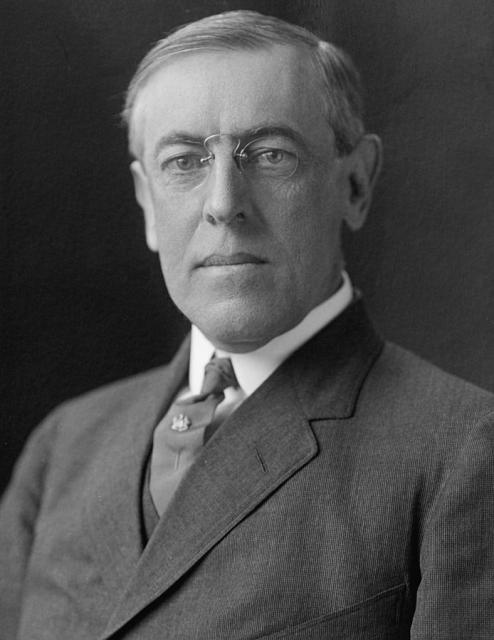
Woodrow Wilson
 USA
USA- Early Life and Education
- Legal Practice and Academic Career
- Political Career: Governor of New Jersey
- Presidency: 1913-1921
- Legacy
Early Life and Education
Thomas Woodrow Wilson was born on December 28, 1856, in Staunton, Virginia, to Joseph Wilson, a Presbyterian minister, and Janet Woodrow. His family had Scottish and Irish roots, with his grandparents emigrating from Northern Ireland. As a child, Wilson struggled with reading and received little formal education until the age of 12. He later compensated for this by studying stenography and pursuing his own education. Wilson attended Davidson College in North Carolina and then Princeton University, graduating in 1879. During his studies, he developed a keen interest in political philosophy and history.
Legal Practice and Academic Career
After graduating, Wilson attended the University of Virginia Law School but did not complete his degree due to health issues. In 1882, he moved to Atlanta to practice law but found the profession unfulfilling. He soon realized that he preferred research and writing. In 1883, he entered Johns Hopkins University to pursue a doctorate in history and political science. He completed his dissertation in 1886 and embarked on an academic career.
Political Career: Governor of New Jersey
In 1910, Wilson was elected Governor of New Jersey. As governor, he introduced several progressive reforms, including workers' compensation laws and direct primaries for party nominations. His leadership earned him national recognition.
Presidency: 1913-1921
In 1912, Wilson was nominated as the Democratic presidential candidate. He ran against incumbent Republican William Howard Taft and former Republican President Theodore Roosevelt, who had formed the Progressive Party. Wilson's election was aided by the division in the Republican camp. He won by a significant margin, receiving 41.8% of the popular vote and 435 electoral votes.
During his presidency, Wilson faced numerous challenges, including World War I. His efforts to maintain American neutrality early in the war were unsuccessful, and the United States entered the conflict in 1917. Wilson's "Fourteen Points" speech in 1918 outlined his vision for a just and lasting peace. For his peace efforts, he was awarded the Nobel Peace Prize in 1919. Wilson also played a key role in the establishment of the League of Nations.
Legacy
Woodrow Wilson's legacy as the 28th President of the United States is complex and controversial. He is credited with advancing progressive reforms and international cooperation, but his wartime policies and racial views have been criticized. Wilson's influence on American history continues to be debated and studied today.


