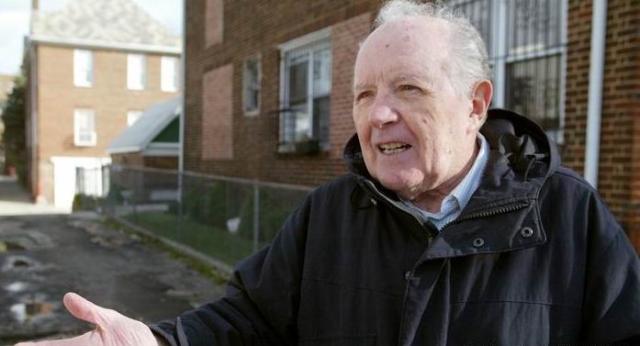
Yakov Palij
 USA
Yakov Palij, also known as Jakiw Palij, was born on August 16, 1923, in a village then in eastern Poland and now in Ukraine. He became a guard at the Nazi-run Trawniki forced-labor camp during the Holocaust, concealed his wartime service when he immigrated to the United States, and spent decades in Queens, New York. After a lengthy legal process, he was deported to Germany in 2018 and died there the following year.
Early life and wartime service
Palij grew up in Piadyki, then part of Poland. During the German occupation of Poland, he trained at the SS camp in Trawniki in 1943 and served as an armed guard at its adjacent forced-labor camp, where Jewish prisoners were held. Trawniki was part of the Nazi system of persecution and mass murder in occupied Poland. On November 3, 1943, German forces carried out a massacre there, shooting about 6,000 Jewish prisoners.
The U.S. Justice Department later presented evidence that Palij’s guard service helped keep prisoners from escaping. A federal judge found that he had participated in Nazi-sponsored persecution. Palij was not convicted in a criminal trial for murder; the U.S. legal case concerned his wartime service and the fraud he committed to enter the country.
Life in the United States
Palij immigrated to the United States in 1949. In his immigration application, he concealed his service and said he had worked on his father’s farm and later in a German factory. He became a U.S. citizen in 1957 and settled in Queens, where he lived for decades.
His wartime history came under scrutiny after investigators received information linking him to Trawniki. In 2003, a federal court revoked his citizenship, finding that he had concealed his wartime activities. The following year, an immigration judge ordered his deportation. The order remained unenforced for years because no country initially agreed to receive him, and Palij continued to live in New York while pursuing appeals.
Deportation and final years
In August 2018, at age 95, Palij was taken from his Queens home and deported to Germany after that country agreed to accept him. His removal was the result of a long U.S. effort to enforce the immigration ruling; it did not result in a criminal trial in Germany. He lived in a care home in Ahlen, Germany, and died in January 2019, aged 95.
Palij’s case became one of the last major U.S. deportation cases involving a former Nazi camp guard. It also illustrated how wartime persecution could remain legally consequential decades later, even when the person had built a quiet life under a concealed past.


