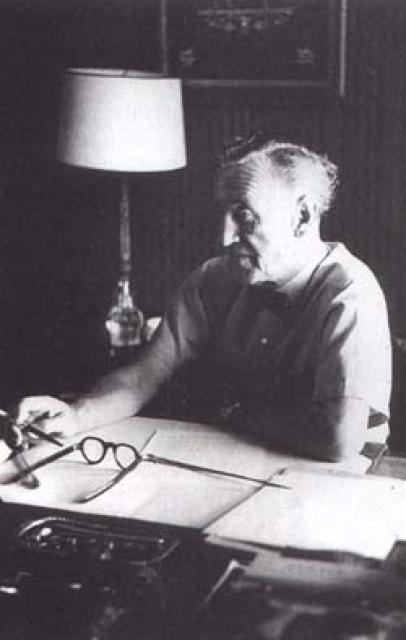
Yan Fleming
 USA
USABiography of Ian Fleming
Ian Fleming, an English writer and the author of the James Bond novels, was born on May 28, 1908. He gained immense wealth and fame as one of the most read authors of the 20th century through his creation of the character James Bond. Bond overshadowed famous detectives like Sherlock Holmes and Poirot, who used their mental faculties to solve crimes. Unlike them, Fleming's hero made quick decisions without much deliberation. Bond's world consisted of luxurious hotels, exotic islands, beautiful women, and high-stakes gambling. He preferred Dom Perignon champagne, Bentley and Aston Martin cars, and the finest porcelain and silverware. Fleming inherited his taste for the extravagant life from his creator.
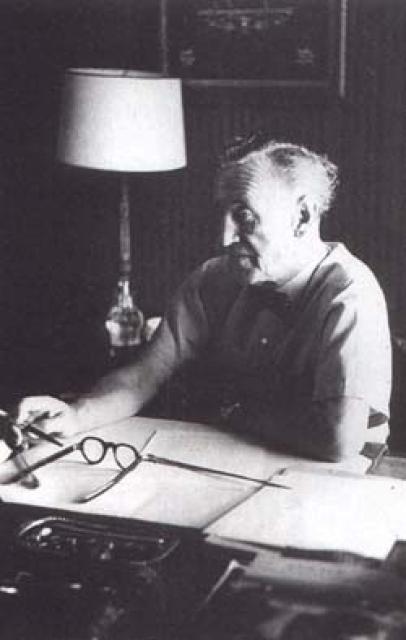
Fleming believed that success and money came from pursuing strong desires and having a lively temperament, rather than through hard work and compromise. He lived his life on his own terms, unafraid of change in professions, relationships, or women. It seemed that Fleming was incapable of violence towards himself, which is why his energetic spirit was inherited by the most popular hero of the 20th century.
Early Life and Career
Ian Fleming was born into a wealthy and noble family. He had the opportunity to receive the most prestigious education. However, he was expelled from Eton, a school that produced British Prime Ministers since 1440, for being involved with a girl. Fleming didn't last long at the Royal Military College, Sandhurst, either, as he went AWOL and was caught. He submitted a report requesting his expulsion and never achieved an officer rank.
Fleming was constantly compared to his father and older brother. His father, Major Valentine Fleming, died heroically during World War I. A eulogy signed by Winston Churchill was published in The Times. His brother Peter, who excelled at Eton and Oxford, became a renowned journalist. In his youth, Ian only stood out for his athletic achievements and his ability to learn languages, including German, French, and even Russian. He aspired to become a diplomat, but failed the Foreign Office exams due to poor English.
Fleming's mother used her connections to get him a job at Reuters. There, he could finally satisfy his adventurous spirit. In 1933, his career as a journalist took him to Moscow, where six English engineers were on trial for espionage. It is believed that it was during this time that Fleming began carrying out assignments for British intelligence. However, journalism didn't pay well, and Fleming desired a lavish lifestyle. He ventured into banking and settled in the most fashionable part of London, near Hyde Park. He hosted high society parties, collected rare books, and pursued beautiful women.
However, Fleming soon grew tired of following stock market quotes. His sense of adventure took over, and in May 1939, he joined the Naval Intelligence Division. Fleming served "on Her Majesty's Secret Service" throughout World War II. He participated in the evacuation of King Zog of Albania from the continent, traveled to the US to coordinate with allies, and led an operation to track down secret laboratories where Germans developed V-2 rockets. It was everything he had been looking for.
However, it was Fleming's literary talent that earned him the admiration of his superiors. His reports and intelligence briefings were unmatched in style and composition. Thanks to his brilliant style and well-thought-out structure, they were as gripping as detective stories. Commander Ian Fleming was also known for his wild imagination, which helped him come up with the most unthinkable special operations. In 1942, he was invited to develop the concept for the Office of Strategic Services, the American military intelligence agency. As a result, he received a personally engraved revolver as a token of appreciation.
Writing Career and Legacy
After the war, Fleming retired from intelligence work, as the routine of being a spy no longer appealed to him. He also had a new idee fixe.
During the war, he had been sent to Jamaica for a naval conference. The absence of bombings, refugees, rationing, and curfews made it a paradise. Fleming decided that this paradise would belong to him.
Unlike most of us, Fleming took his weaknesses seriously. He acquired a small bungalow in Jamaica called Goldeneye, which would later become the title of one of his James Bond novels. It was in this house that the character James Bond was born.
Ian Fleming, a womanizer and lover of women, was involved with a married woman named Ann Rothermere in the years following the war. When she became pregnant, 43-year-old Fleming decided it was time to settle down. While Ann finalized her divorce, he lived in Jamaica and wrote his first novel, "Casino Royale."
Since then, Fleming only embarked on dangerous adventures in his dreams, alongside his fictional character, James Bond.
Interestingly, Fleming borrowed the name James Bond from a well-known ornithologist who authored a book called "Birds of the West Indies." The full namesake of Agent 007 brought him some trouble. He received calls from dubious women and was hounded by journalists. Professor Bond's wife even wrote a letter to Fleming, who apologized and invited the Bonds to visit him in Jamaica. At customs, Professor Bond's luggage was thoroughly searched, and he was questioned about whether he had any weapons.
Fleming was 45 years old when his first James Bond novel was published. In the first year, it sold 7,000 copies. A year later, the American publisher Macmillan bought the rights to publish his novels.
Fleming's works were published in millions of copies in softcover and in a new pocket format, which was revolutionary at the time. People read his books on trains and planes, at the beach, and before going to bed.
Serious critics struggled to accept the existence of the James Bond books, criticizing them for their sexual content and violence. However, while they disapproved, Bond conquered the world.
The novels by the English writer became a part of American popular culture. In 1961, US President John F. Kennedy admitted to reading Fleming in his spare time, with his favorite novel being "From Russia with Love."
For Fleming, writing was for pleasure and money. He did not intend to change the world or human nature. According to his own words, he didn't appeal to reason or the heart; instead, he aimed for somewhere in the lower abdomen.
Fleming released one novel a year. His royalties increased over time. After the publication of "Diamonds Are Forever" in 1956, he purchased an 18th-century castle near Canterbury, not far from London. Following the sale of the film rights to "From Russia with Love" (the film was released in 1963), Fleming acquired a large estate in Wiltshire, complete with a palace and two thousand acres of land.
It was after the film adaptations that Fleming achieved true fame. Over the course of 35 years since the premiere of the first film, eighteen Bond movies were made. The last one, "Tomorrow Never Dies," was released in 1997, 33 years after Fleming's death.
Fleming died of a heart attack after returning from a golf club meeting. Ten years of immense fame and insane wealth had taken a toll on the brave spy. Until his last day, Fleming smoked heavily and consumed half a liter of gin daily. He did what he liked, as always.


