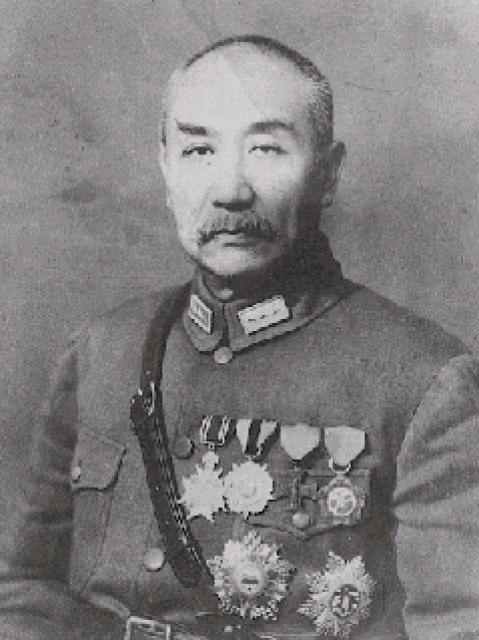
Yan Xishan
 China
ChinaIntroduction
Yang Hucheng, also known as Yan Xishan, was a military and political leader in China. He served as the Premier of the Republic of China from 1949 to 1950. Born on October 8, 1883, in Xinzhou, Shanxi province, he played a significant role in the history of China during the early 20th century.
Early Life and Military Career
Yang Hucheng received his education at the Taiyuan Military Academy in 1904 and joined the military service. From 1908 to 1910, he underwent training in Japan at the Imperial Army Academy, where he became a member of a secret organization formed by officers who wanted to overthrow the ruling Qing Dynasty.
In October 1911, Yang was appointed as the commander of the garrison regiment in Taiyuan, the administrative center of Shanxi province. During the Xinhai Revolution (1911-1912), he sided with Yuan Shikai and, after becoming the military governor of Shanxi, established a regime of dictatorial rule in the province.
Political Activities
In 1915, not approving Yuan Shikai's intention to abandon the republic and declare himself the emperor of China, Yang supported Tan Yankai and was rewarded with the position of civil governor of Shanxi. After Tan Yankai's downfall in 1918, Yang maintained his position for several years, successfully maneuvering between the most influential political factions that sought to gain his support.
In 1925, together with the military governor Feng Yuxiang, Yang expelled the warlord Zhang Zuolin's forces from the northern regions of central China and engaged in combat against the 1st National Revolutionary Army led by Feng Yuxiang. In 1927, he switched sides to support the Kuomintang and was appointed by Chiang Kai-shek as the commander of the 2nd Army Group.
He participated in the Northern Expedition of the Kuomintang, leading the troops into Beijing in June 1928. From 1928 onwards, he served as the Minister of Internal Affairs of the Republic of China and commander of the Beijing garrison.
In 1929, he opposed Chiang Kai-shek's policies, and in 1930, he led a rebellion against his government in Nanjing, involving garrisons from Beijing, Tianjin, and Jinan. When the rebellion was suppressed, he fled to Japan.
After the declaration of amnesty in 1931, Yang returned from exile and took up the post of governor of Shanxi province. Through successful administrative and political measures, he was able to maintain a stable situation and implemented progressive reforms in the province.
Later Years and Legacy
In 1936, he repelled the Red Army's attack on Shanxi.In June 1937, after the invasion of China by Japanese forces, Yang successfully organized armed resistance. Amidst the power struggle between the occupying forces, the Kuomintang, and the Chinese Communists, he managed to maintain his authority in the province.
After the end of the war, Yang, who had several divisions under his command, continued to hold Taiyuan from 1945 to early 1949 but ceased resistance in April 1949 after the city was captured by the People's Liberation Army. Stripped of power and removed from military control, General Yang Hucheng, appointed by the Kuomintang as the Premier of the Republic of China on June 3, 1949, along with other members of the government, resided in Guangdong province until he flew to Taiwan on December 8, 1949. He served as the Prime Minister until January 26, 1950, and then became an advisor to the President of the Republic of China for over 10 years, until May 23, 1960.
Yang Hucheng passed away on July 22, 1960, in Taipei. His contributions and political career played a significant role in shaping the history of China during the turbulent times of the early 20th century.




