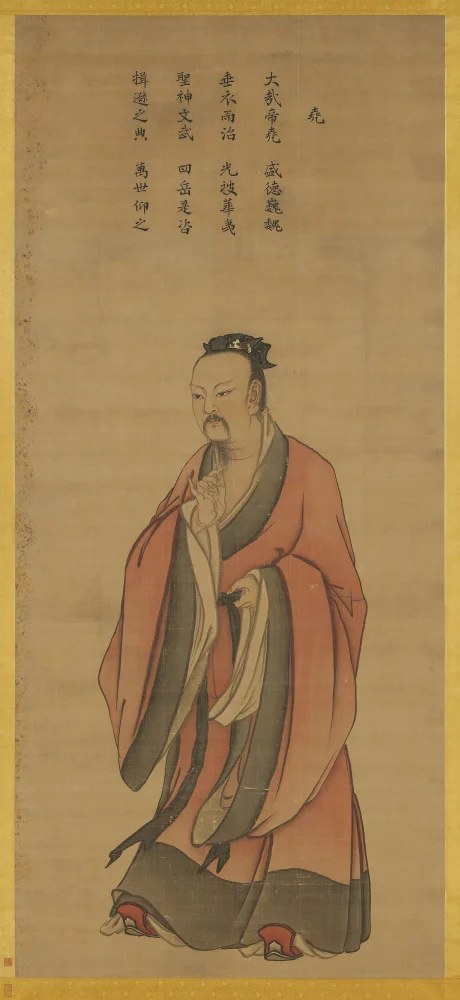
Yao
Yao occupies a special place in Chinese memory as the sage ruler whose authority came from virtue rather than force. Accounts of his reign describe an orderly realm, careful attention to the calendar, and a defining choice: instead of passing power to his own son, he selected the capable Shun as successor. These stories became enduring models of good government, though they belong to ancient tradition rather than verifiable biography.
The Sage Ruler in Early Texts
Yao, also known by the traditional name Tao Tang, is counted among the Five Emperors of early Chinese lore. The earliest major narratives about him appear in the *Book of Documents* and the *Records of the Grand Historian*. The latter was compiled centuries after the legendary age it describes, so its account preserves how later generations imagined ideal leadership rather than a contemporary record of Yao’s life.
In these texts, Yao is portrayed as measured, compassionate, and attentive to the needs of the people. He established officials to observe the sun, moon, and stars and set the calendar, linking the ruler’s authority to the ordering of the seasons. The picture is of a monarch whose first duty was to keep society in balance.
The Flood and the Search for a Successor
The narratives also place Yao’s reign amid a devastating flood. His court struggled to control the waters, and the failure of the official Gun led to a search for someone more capable. Yu, Gun’s son, eventually succeeded where his father had not, and later tradition made him the founder of the Xia dynasty.
Yao’s search for a successor forms the best-known part of his story. Rather than rely on hereditary succession, he asked his ministers to recommend someone worthy of governing. They proposed Shun, a man said to be living in obscurity despite his royal ancestry. Yao tested his character and abilities, including by marrying his two daughters to him and assigning him a series of responsibilities. In the *Records of the Grand Historian*, Shun gradually shared in government before succeeding Yao.
A Model of Virtuous Rule
The story of Yao’s choice of Shun became central to Confucian political thought. It presented rulership as a moral trust and suggested that the best successor should be selected for virtue and ability, even if he was not the ruler’s son. Later philosophers invoked the Yao-Shun succession as an example of government serving the common good.
The tradition also had its complexities. Not every ancient account tells the succession story in the same way, and later writers debated whether Yao willingly transferred power or was displaced. That disagreement shows how the legend could be adapted to arguments about legitimacy, hereditary rule, and merit.
Legacy
There is no secure historical record that allows Yao’s life to be reconstructed in modern biographical terms. His influence instead lies in the political ideal attached to his name: a ruler who observed the natural order, appointed capable officials, answered crises, and entrusted the throne to a worthy successor. For centuries, Yao and Shun stood together as shorthand for sage government in Chinese culture.