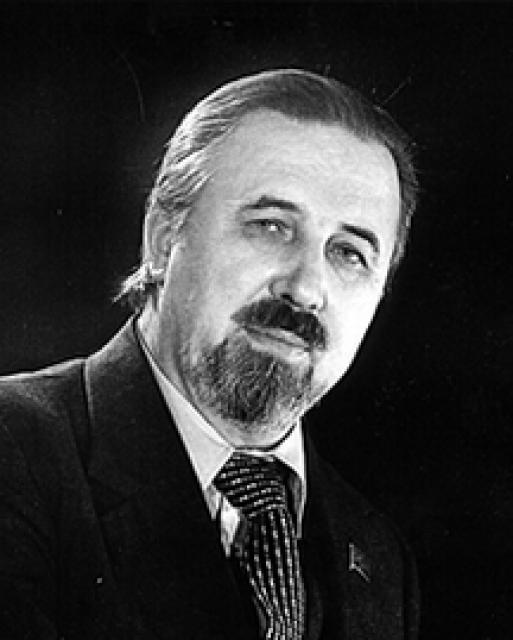
Yevgeniy Glebov
 Belarus
Biography of Evgeny Glebov
Evgeny Glebov was a Belarusian Soviet composer, conductor, and educator. He was born on September 10, 1929, in the city of Roslavl (now in the Smolensk region). He came from the noble Sokol-Chernilovsky family on his mother's side, but the surname was lost as it was passed down through the maternal line. This helped his family survive the Stalinist repressions. On his father's side, Glebov came from a family of priests. His father was a talented musician who could play a variety of instruments and had a good ear for music. When Glebov was still a child, his father left the family. He tried to return, but Glebov's mother refused to take him back. As a result, Glebov was raised by his grandmother, former princess Klavdia Stepanovna, and his mother, Raisa Fedorovna, who worked as an engineer in labor standardization.
According to other sources, Glebov came from a family of railway workers. He graduated from secondary school in 1947 and then entered the Roslavl Railway Technical College. After completing his studies, he worked as a wagon inspector in Mogilev. From a young age, Glebov was fascinated by music. He taught himself to play the mandolin, guitar, and balalaika, and at a young age, he began composing various musical works such as songs, romances, and pieces. While studying at the Roslavl Railway Technical College, he led the student choir and orchestra. While working in Mogilev, he became friends with students from the Mogilev Music School and started learning the basics of music.
Glebov tried to enter a music school, but the director, upon learning that he did not know how to read music and had never encountered music theory, rejected him as unsuitable for the profession. In 1950, recommended by I.I. Zinovich, Evgeny Glebov went to Minsk to apply to the conservatory along with graduates of the Mogilev Music School. As a result, he ended up in A.V. Bogatyrev's composition class. In 1951, he created his first major work, "Fantasy for Piano and Symphony Orchestra."
Initially, studying was very difficult for Glebov, but thanks to his persistence, he was able to catch up. The most challenging aspect was learning to play the piano. Glebov asked Bogatyrev, who was not only his teacher but also the rector of the conservatory, to give him private lessons every Sunday in the rector's office, allowing him to fill in the gaps and perform Grieg's concert at the end of his education. During his studies, Glebov faced financial difficulties. His grandmother received a small pension in Roslavl, and his mother, Raisa Fedorovna, had a modest salary. Therefore, he did not receive any financial support from his family. Once, during a lesson, Glebov lost consciousness due to hunger, after which Bogatyrev appointed him as an inspector of the conservatory choir, which allowed him to have a small income.
He graduated with honors from the first two courses. On the third course, he began receiving a Stalin scholarship, which was his first significant income. After graduating from the conservatory in 1956, Evgeny Glebov became a teacher of theoretical disciplines at the Minsk Music School, combining his teaching and creative activities with the position of head of the music department and conductor at the Young Spectator Theater. In 1955, he became a member of the Belarusian Communist Party. He was elected to the board and became the deputy chairman of the board in 1980. He also served as a member of the audit commission of the All-Union Communist Party and the board of the Union of Soviet Societies for Friendship and Cultural Relations with Foreign Countries. Glebov was a deputy of the Supreme Soviet of the Belarusian SSR.
Since 1971, he taught composition at the Belarusian State Conservatory. He was convinced to engage in teaching by the first secretary of the Central Committee of the Communist Party of Belarus, Pyotr Mironovich Masherov. Initially, Evgeny Glebov was reluctant because it took up a lot of time, but Masherov was able to persuade him by saying, "Don't refuse. Think about what kind of ensemble of like-minded people you can prepare." Throughout his years at the conservatory, Evgeny Glebov trained over 40 students. Some of his notable students include Leonid Zakhlevny, Jadwiga Poplawska, Vasily Rainchik, Eduard Khanok, Vyacheslav Kuznetsov, Vladimir Kondrusevich, and Dmitry Dolgalev.


