Yoshihide Otomo
 Japan
JapanBiography of Yoshimide Otomo
Yoshimide Otomo, a Japanese composer and multi-instrumentalist, first gained international attention in the 1990s as the leader of the rock group 'Ground Zero'. Since then, he has worked in various musical environments, ranging from free improvisation to noise, avant-garde, and contemporary classical music. Otomo is a true pioneer in the field of electroacoustic improvisation, and he has worked on creating a number of groundbreaking recordings on labels such as 'Erstwhile Records'.
Early Life and Education
Yoshimide Otomo was born on August 1, 1959, in Yokohama, Japan. In 1979, he began studying at Meiji University, where he focused on ethnomusicology, particularly Japanese pop music during World War II and the development of musical instruments during the Chinese Cultural Revolution. Several samples of these instruments and music from that period were included in his works. While studying, Yoshimide played in a rock band, but soon shifted his focus to improvisation, discovering free jazz musicians and improvisers such as guitarist Derek Bailey, saxophonist Kaoru Abe, and guitarist Masayuki Takayanagi, from whom Otomo took lessons.
Music Career
In 1981, Otomo started playing guitar in an improvisational manner at the first Japanese house club, 'Jazu Kissa', in Tokyo, using devices like the Roland drum machine or a simple cassette player. He is considered the father and pioneer of house music in Asia. Throughout the 1990s, 'Ground Zero' was his main project, formed in 1990. The lineup of the group changed several times, and they played music in various styles, characterized as noise rock with experimental elements and a heavy emphasis on different samples, creating musical collages. For example, the album 'Consume Red' features a sample of Korean musician Kim Seok Chul playing the double-reed instrument hojok, which permeates the entire hour-long recording until the musicians gradually drown it out with their improvisations and increasing volume. 'Ground Zero' ceased to exist in 1998. Before its disbandment, Otomo formed two electronic improvisational collectives: 'Filament' with Sachiko M and 'I.S.O.' with Sachiko M and Yoshimitsu Ichiraku. These groups moved away from the chaotic postmodern mix of 'Ground Zero' and the use of samples, instead incorporating sine waves, electronic clicks, and noises into their music.
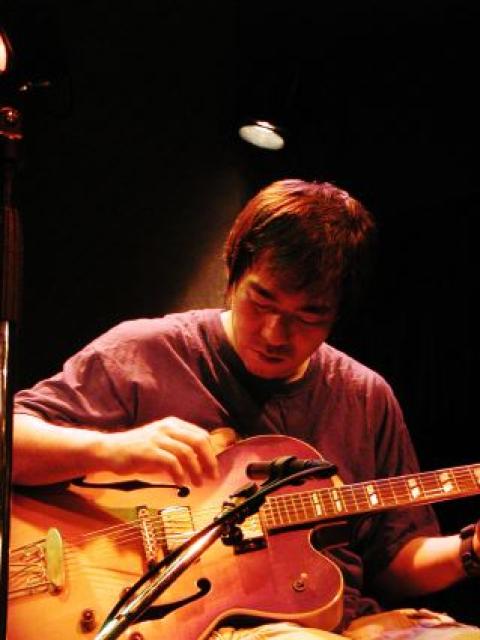
In the late 1990s, Otomo formed a new ensemble called 'Otomo Yoshihide's New Jazz Ensemble', which leaned towards more traditional jazz, but still included sine waves by Sachiko M and passages of noise. The group released 'Flutter and Dreams' on the 'Tzadik' label. In Japan, the ensemble established a stable lineup and became known as 'Otomo Yoshihide's New Jazz Quintet', releasing albums such as 'ONJQ LIVE', 'ONJQ+OE', and 'Tails Out' between 2002 and 2003. Otomo also presented collaborative albums, such as 'Moving Parts' with turntablist Christian Marclay in 2000 and 'Turntables + Computers' with Japanese electronic musician Nobukazu Takemura in 2003. In addition, Otomo plays in the quartet 'FEN (Far East Network)' with three other musicians from different parts of Asia: Yuen Chee Wai from Singapore, Ryu Hankil from South Korea, and Yan Jun from China. 'FEN' made its debut at a festival in Marseille in 2008 and has since regularly performed in many countries. The album 'Without Kuryokhin' in 1998, by Otomo and Kenny Millions, is dedicated to the memory of Russian jazz musician and experimenter Sergey Kuryokhin.