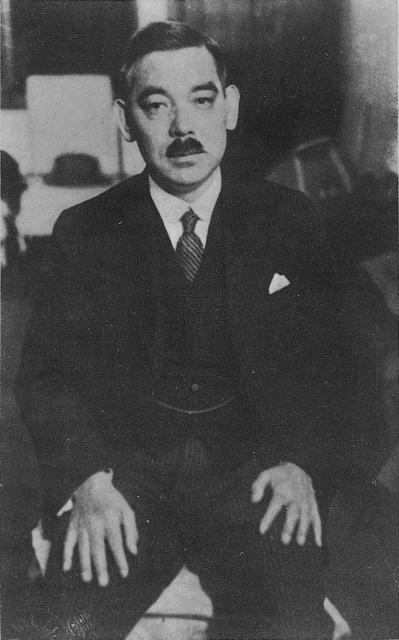
Yosuke Matsuoka
 Japan
Japan- Biography of Yasuke Matsushita
- Early Life and Education
- Diplomatic Career
- Conference in Versailles and Business Career
- Tripartite Pact and Talks with the Soviet Union
- Downfall and Legacy
Biography of Yasuke Matsushita
Yasuke Matsushita was a Japanese politician and diplomat who served as the Minister of Foreign Affairs of Japan from 1940 to 1941. He was one of the initiators of the Tripartite Pact between Germany, Italy, and Japan on September 27, 1940.
Early Life and Education
Yasuke was born in Yamaguchi Prefecture, Japan. He received his higher education at the University of Oregon in the United States, where he graduated with distinction from the law faculty at the age of twenty. During his studies in the States, Matsushita became fluent in English.
Diplomatic Career
At the age of twenty-four, Yasuke became a consul of Japan in Shanghai. In 1906, he was awarded the Order of the Rising Sun for his contributions during the Russo-Japanese War, despite not participating in the military actions. After serving in Shanghai, he was appointed as a secretary of the Ministry of Internal Affairs in Tokyo.
He then worked as a secretary at the embassy in Belgium and later in China, where he received positive reviews from both the Chinese and Japanese governments for his work. From 1912 to 1913, Yasuke served in the embassy in St. Petersburg, Russia, and later transferred to the United States in the lead-up to World War I. He returned to Tokyo in 1917 and held positions as a secretary of the Ministry of Foreign Affairs and secretary to the prime minister.
Conference in Versailles and Business Career
In February 1919, Matsushita was part of the Japanese delegation sent to the peace conference in Versailles. After returning to Japan in the summer of 1912, he left the Ministry of Foreign Affairs to pursue a career in business. He became the director of the South Manchurian Railway Company, where he worked for eighteen years.
Tripartite Pact and Talks with the Soviet Union
Yasuke played a significant role in the Tripartite Pact, advocating for closer cooperation between Japan and the rising Nazi regime. He proposed including the Soviet Union as a fourth party in the alliance, which later led to the signing of the Molotov-Ribbentrop Pact. In March 1941, Matsushita traveled to Moscow for negotiations with Molotov and Stalin. He proposed a non-aggression treaty, while Molotov requested a neutrality pact. Matsushita sought time to consult with the German side, and after negotiations on March 27, he returned to Moscow. The neutrality pact was signed on April 13 in a solemn ceremony at the Kremlin.
Downfall and Legacy
In July 1941, Japan decided to initiate military operations in the south, known as the "Singapore Option," a plan that Matsushita initially opposed. The United States became aware of Japan's plan to attack the Soviet Union on July 4, 1941, leading to tensions. Although the official response from the Japanese government denied any intention to expand the war to the Asian region, Matsushita hinted to the American ambassador that external pressures could change his government's plans. On July 16, 1941, the government was dissolved, and Matsushita was replaced by Admiral Teijiro Toeda.
Matsushita was mostly forgotten until he faced charges at the International Military Tribunal in 1946. He did not admit to the crimes he was accused of, and the proceedings were halted by his death on June 27, 1946.