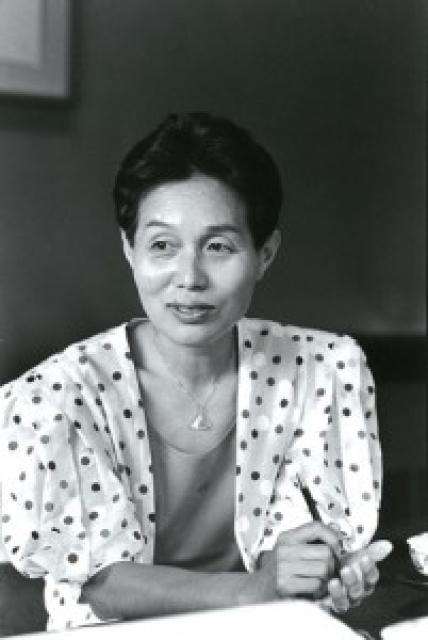
Yumiko Kuraxasi
 Japan
Japan- Early Life and Education
- Literary Debut and Early Controversies
- Marginalization and Literary Experimentation
- Late Works and Legacy
Early Life and Education
Yumiko Kurahashi was born in Kami, Kochi Prefecture, Japan in 1935. She began her studies in Japanese literature at Kyoto University but transferred to Meiji University after one year, where she studied French literature and was mentored by Masanao Saito. Kurahashi also attended lectures by prominent Japanese literary scholars of the postwar era, including Mitsuo Nakamura, Kenichi Yoshida, and Ken Hirano.
Literary Debut and Early Controversies
During her time at Meiji University, Kurahashi published her debut novel, "The Communist Party," in 1960. The work was a sharp satire of the leftist sentiments prevalent in the student movement of the time. It received high praise from critic Ken Hirano, who published a review in the "Mainichi Shimbun."
Kurahashi's subsequent novel, "The End of Summer," was also nominated for the Akutagawa Prize. However, she did not receive the award. Despite this setback, Kurahashi was recognized as part of the "New Third Wave" of writers, along with Takeshi Kaiko, Shintaro Ishihara, and Kenzaburo Oe.
Her 1961 novel "Dark Voyage," written in a distinct second-person perspective, sparked controversy among critics. Jun Eto accused Kurahashi of plagiarism, claiming that it imitated Michel Butor's novel "Changing." A heated debate ensued, with Kurahashi and her defender Takeo Okuno opposing a group that included Eto, Oe, and Kodji Shirai.
Marginalization and Literary Experimentation
In 1962, Kurahashi dropped out of university and gradually retreated from the public eye. She married Tomihiro Kumagaya, a producer at NHK, in 1964 and spent a year at the University of Iowa in the United States. Her experimental novel "The Adventures of Q the Needleman" (1969) received mixed reactions.
A radical shift in Kurahashi's work occurred with the publication of "The Floating Bridge in a Dream" (1971), which was largely ignored by critics. "Cruel Fairy Tales for Adults" (1984), a subversion of traditional fairy tales, became her most popular work during her lifetime. She was also awarded the Izumi Kyoka Prize for her dystopian novel "Journey to Amamon" (1987).
Late Works and Legacy
In her later years, Kurahashi focused on literary translation, including works by Antoine de Saint-Exupéry and Shel Silverstein. She died at the age of 69 from dilated cardiomyopathy but had consistently refused life-saving surgeries.
Kurahashi's work is known for its abstractness, lack of morality, and political neutrality. She challenged the conventions of Japanese literature and remained an enigmatic figure throughout her career. Her writings explore themes of the anti-world, the fluidity of identity, and the transformative power of language.
Kurahashi's work has received more recognition in the West than in Japan. Her major works have been translated into English and German, allowing her unique literary vision to reach a global audience. Despite the controversies that surrounded her early career, she is now considered a significant figure in the postmodernist literary movement.