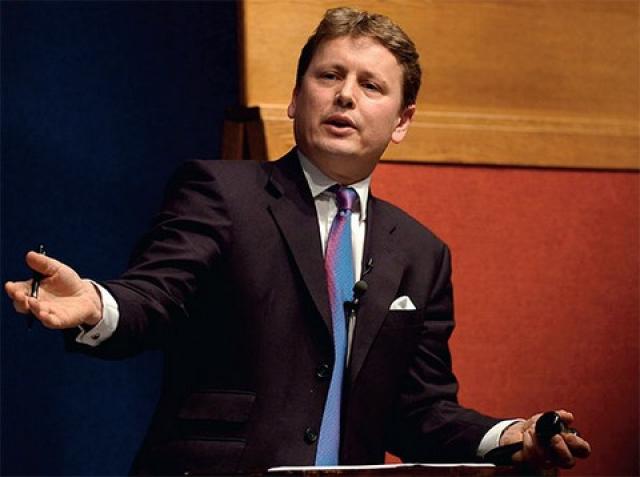
Yusi Pulkkanen
 Great Britain
Biography of Jussi Pulkkanen
Jussi Pulkkanen, the President of Christie's Europe and the Middle East, will celebrate the 25th anniversary of his work at one of the world's oldest auction houses next year. Born to Finnish parents, Jussi moved from Finland to England in the early 1960s. He completed his schooling and university education here, and then took an art course at Christie's. His career at Christie's began in the department of contemporary graphics. Interestingly, the first catalog he participated in was dedicated to the auction of "Imperial and Post-Revolutionary Russian Art". He spent about four years working on the topic of "the book of Russian avant-garde". The next major step was his work in the Impressionism and Modernism department, which he led from 1995 to 2006. Since 1997, he has also been an auctioneer, leading the main evening sales in London. His personally commissioned gavel has marked new world price records with seven zeros.
Early Career at Christie's
Jussi, you joined Christie's more than two decades ago and have not parted ways with the auction house since then. Was it a conscious choice from the very beginning or, as often happens, were the circumstances such that you stayed? - In the 1980s, Christie's held a special place in European culture. At that time, I was a student at Oxford, studying English literature. I first attended an auction in 1985 when Christie's put Montaigne's "The Adoration of Mary" up for sale. The painting sold for £8.1 million, which was the highest price for an artwork acquired at an auction at that time. I even wrote an article in the newspaper about this sale - I was intrigued by the relationship between art and money. I was searching for my path in life, and my grandfather had a strong influence on me during my childhood. He was a writer and theater critic, the president of one of Finland's leading theaters. Although I was studying in England, I spent all my vacations in Finland. I had the opportunity to travel on tour with famous people like Marcel Marceau. Did you start as an art dealer? - I always wanted my future career to be related to art, so after graduating from university and completing the course at Christie's, I decided to become an art dealer. I was thrilled with my work at a leading dealer on Bond Street. We traveled with exhibitions to America, and things were going well. Therefore, when I unexpectedly received an invitation for an interview from Christie's in 1986, I declined - I didn't want to change anything. But then, I had lunch with my father, and I mentioned that I had turned down a job at Christie's. He ordered me to call them immediately and say that I agreed. "The least this job will give you is the opportunity to observe the full panorama of the art market on a global scale for two years. Then you can continue your career as a dealer." So, in 1986, I ended up at Christie's, and two years later, I was appointed Deputy Director of Christie's UK. Later, I moved to the Impressionism and Modernism department, which I eventually headed, and that determined my fate. You were probably one of the youngest specialists in such a high position in the history of this auction house! Did you regret not returning to the dealer career? - Not only my status at Christie's changed, but the overall picture of the art market has radically changed over the past 20 years, and the opportunity to be at the center of this situation is very exciting and thrilling for me. In the 1980s, Christie's had a turnover of £4.7 billion, and in the last ten years, it has reached £18 billion. The sale of Van Gogh's "Sunflowers" at Christie's in 1987 for $39.9 million was a significant event: the art market of old masters became historical, and modernism became the driving financial force of the new market. I consider the 1980s the golden age of the art market, and for me personally, it was the beginning of an adventure that continues to this day. In one of your interviews, you mentioned the "new Medici" - collectors from countries with fast-growing markets such as Russia, China, India, and the Middle East. When did Christie's start operating in Russia? - In 2005, I was appointed President of Christie's Russia. I was amazed at how quickly the Russians became some of the most active buyers in London, New York, Hong Kong, and Geneva. Russians have influenced our art market in various areas - acquiring furniture, jewelry, works of old masters, impressionists, contemporary art, and, of course, Russian art. Our sales to Russian clients have tripled in the last few years. What is your opinion of Russian collectors? - They are characterized by passion, mobility, confidence, and deep knowledge of the subject. I think this is because art has always been a part of life for many Russians, and your culture has traditionally played a significant role in literature, music, ballet, and the fine arts... You are the author of the idea to open Christie's representative offices and auction halls in the Middle East... - When we opened in Dubai in 2005, no one had sold Middle Eastern contemporary art at auctions before and, naturally, no one could predict what would come out of it. I was interested in getting involved in this, and over five years, our sales in Dubai reached $170 million. Now, Russian and Middle Eastern clients compete with our traditional buyers - Americans and Europeans. A new generation of collectors has emerged, and the market has changed, as it does every ten years. As the President of Christie's Europe and the Head of European Business Development, you have done a lot to make the auction house now have 54 offices in 31 countries and 10 trading platforms worldwide. However, your activity is not limited to this. For the past 13 years, you have been conducting the main evening auctions at Christie's... - Yes, I make my living as an auctioneer. I think I have a natural instinct for being an auctioneer. Although I didn't decide on this right away, but after serving at Christie's for almost ten years. When you sell big names like Monet, Picasso, Klimt, you look into the hall where about 600 people are present, and you immediately see those who want to own this artwork: their faces light up, their posture changes, they look at you with that special look, lean forward - body language is phenomenally eloquent! Maybe after about five years of being an auctioneer, I developed an intuitive sense of who will buy a particular work. And it's no secret that an experienced auctioneer can increase the sales figure by 15-20%. Standing behind the podium, on the stage of the auction action, and looking at the audience, how many of them do you personally know or have seen at previous sales? - 90% of the audience! (Laughs.) It's like a huge family! What is extremely important is this moment of personal acquaintance when you know a person and their collection, and when you can say from your podium, "Are you sure you don't want to fight for this lot anymore?" And you say this because you know firsthand how much this collector would like to add a beautiful Matisse or Léger to their collection, and you have had conversations about it for the past 15-20 years. Have you ever been on the other side of the barricade - as a buyer? Do you personally collect art or only sell it? - We have a family collection - my parents collected works by Scandinavian artists. I continue the collection, acquiring Scandinavian and European glass, works by contemporary Scandinavian artists. I buy works by authors I am friends with or those whose works resonate with me. I am probably a very selfish collector: my collecting activity is based solely on personal preferences! What keeps you at Christie's for almost a quarter of a century? - I enjoy interacting with collectors from all over the world, absorbing their knowledge, understanding their tastes and collecting experiences. I take pleasure in orchestrating the scene in the auction room. It's like skydiving: everyone knows it's something extraordinary, but they can only truly understand it by experiencing it personally. I would compare that moment of free flight to the state of an auctioneer in the room! And, of course, the intoxicating joy of feeling, touching, and holding masterpieces of art every day!