
Zac Vawter
 USA
USAAmerican with a Bionic Leg
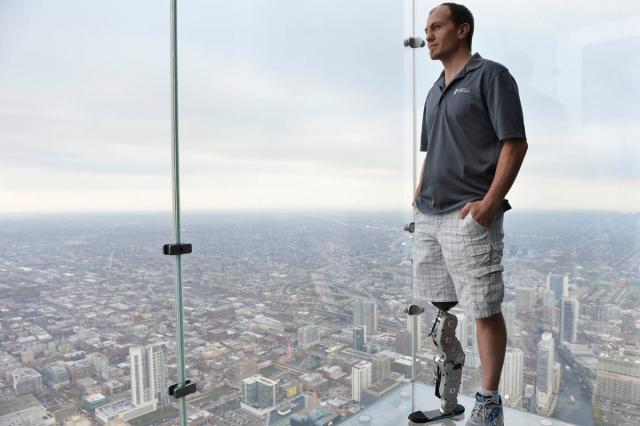
Zak Vawter, an American who lost his right leg in a motorcycle accident, has participated in a charity event called "SkyRise Chicago" by climbing the 103rd floor of the Willis Tower using a bionic prosthesis. Vawter was invited to participate by the Rehabilitation Institute of Chicago, where he is undergoing treatment for his injury. The climb, consisting of 2,100 steps, was not an easy task even for trained athletes. Vawter prepared for the ascent by training on a small escalator in the gym, while researchers continued to perfect the technical aspects of the prosthesis, which was designed to respond to its owner's thoughts.
A Revolutionary Prosthesis
The bionic prosthesis, weighing around ten kilograms and equipped with two motors, is controlled by electrical impulses from Vawter's muscles through the tendons below his knee. When Vawter thought about climbing the stairs, the microcomputer in the prosthesis coordinated the movements of his knee and ankle. This computerized prosthesis, resembling a creature from a science fiction movie, has been in existence for several years and has replaced amputated arms for many patients, thanks to the groundbreaking developments at the Rehabilitation Institute of Chicago. Since lower limb loss is more common in accidents, the institute focused on creating a prosthesis capable of replacing lower limbs.

An Ambitious Research Project
The climb up the Willis Tower served as an ambitious research project for the specialists involved, including Joanne Smith, the CEO of the Rehabilitation Institute. Testing the prosthesis under extreme conditions was a crucial step towards its future use. While only a few patients will use such advanced prostheses for similar purposes in the future, this prototype has successfully withstood the most rigorous tests.
A Future Endeavor
After returning to Yelm, Washington, where he resides with his wife and two children, Vawter will leave the experimental prosthesis in Chicago. Scientists will continue their work on it, and it will take a few more years before such prostheses become available on the market. The $8 million project is funded by the US Department of Defense and involves the collaboration of Vanderbilt University, the Massachusetts Institute of Technology, the University of Rhode Island, and the University of New Brunswick.


