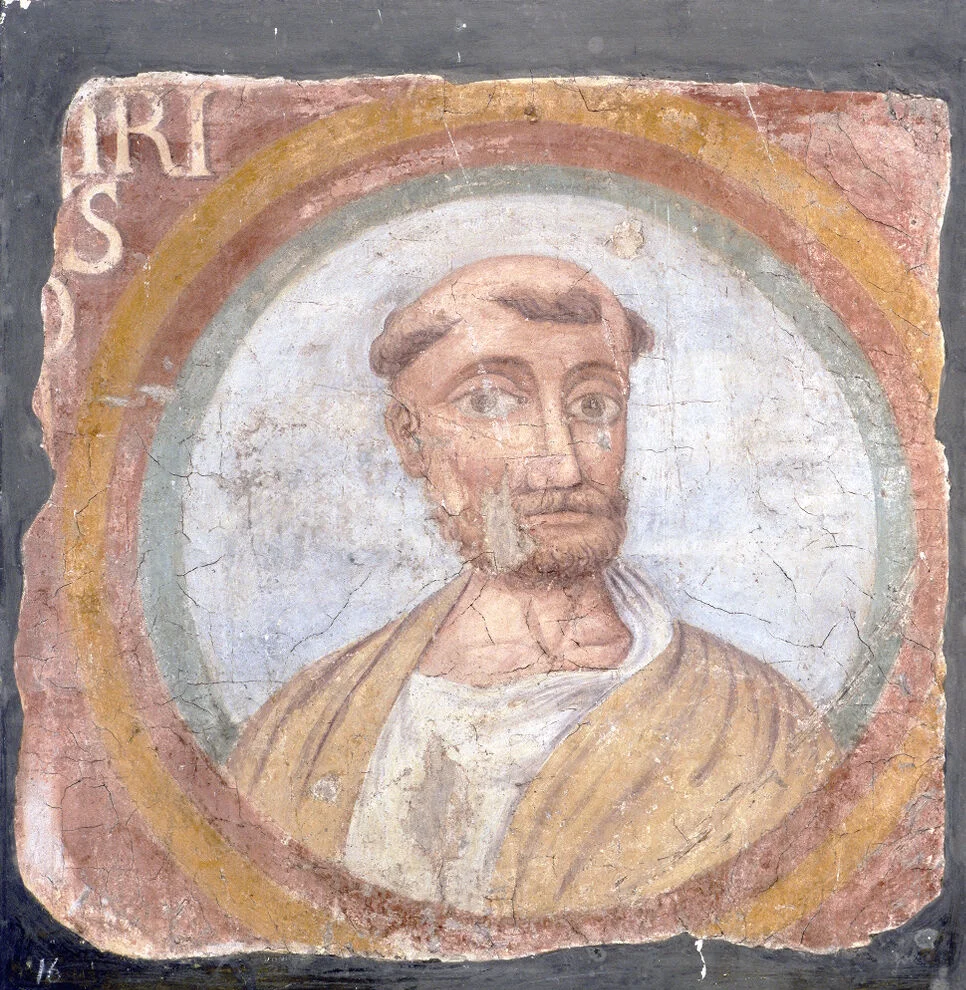
Zephyrinus
Zephyrinus led the Christian community in Rome at a moment when it was growing, organizing its institutions and arguing over how to explain the relationship between God the Father and Jesus. Remembered as a pope and saint, he is also one of the most disputed early bishops: much of what is known about his leadership comes from Hippolytus, a sharp theological critic who accused him of indecision and poor judgment.
A bishop in a growing community
Zephyrinus succeeded Victor I as bishop of Rome around 199 and held the office until his death, traditionally dated to 217. Later Catholic lists count him as the fifteenth pope. Details of his birth and early life are uncertain, and the surviving accounts offer little dependable information about his background.
One consequential appointment involved Callixtus, a Christian who had previously experienced hardship and controversy within the community. Zephyrinus brought him back to Rome and entrusted him with overseeing a Christian burial ground along the Appian Way. The cemetery later became known as the Catacomb of Callixtus. It grew into an important place of burial and remembrance, with a section that became the resting place of several later bishops of Rome. The appointment also placed Callixtus in a prominent position; after Zephyrinus died, he succeeded him as bishop.
The dispute over Christ
The theological conflict that defined Zephyrinus’ reputation concerned “monarchian” interpretations of Christianity. Some believers emphasized God’s unity so strongly that they described the Father and Son as different manifestations, or modes, of the one God. Their opponents argued that this blurred the distinction between Father and Son. These disagreements were still developing, and later labels such as “modalism” can make the early debate sound more settled than it was.
Hippolytus, a priest and theologian who opposed these views, portrayed Zephyrinus as too accommodating to their proponents. In his account, Zephyrinus’ assistant Callixtus also shaped the bishop’s position, and the two men resisted Hippolytus’ teaching. Hippolytus’ testimony is valuable because he was close to the events, but it is openly polemical: he criticized both leaders and accused them of incompetence and greed. Historians therefore treat his account as evidence of a real dispute, not a neutral portrait of Zephyrinus.
A legacy of organization and controversy
The surviving record does not show Zephyrinus issuing a formal doctrinal ruling that ended the controversy. His leadership appears instead to have centered on holding together a Christian community whose members disagreed about doctrine, discipline and authority. That was no small task in a city where Christian communities were still organizing their shared property, burial practices and leadership.
Zephyrinus died in Rome around 217 and was succeeded by Callixtus. Later Christian tradition honored him as a saint, though the evidence does not establish that he died as a martyr. His legacy rests on two contrasting impressions: he helped strengthen the practical life of Rome’s Christians, especially their communal burial arrangements, while his handling of theological dissent became a lasting point of contention.