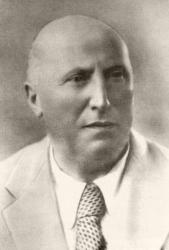
Aaron Douglas
 USA
- From Topeka to art school
- Finding a visual language in Harlem
- Murals that told Black history
- A teacher at Fisk
- An enduring legacy
Aaron Douglas turned the visual language of the Harlem Renaissance into a distinctive art of silhouettes, rhythmic lines and radiating light. Through paintings, murals and book illustrations, he connected African American life in the United States with African heritage and modern art. His work helped define a new cultural movement and influenced generations of artists and students.
From Topeka to art school
Douglas was born on May 26, 1899, in Topeka, Kansas. His father, Aaron Sr., was a baker, and his mother, Elizabeth, encouraged his early interest in drawing. After high school, Douglas worked in Detroit, including in factories, and took evening art classes before enrolling at the University of Nebraska in 1918.
In 1922, he became the university’s first African American graduate with a bachelor of fine arts degree. He then taught art at Lincoln High School in Kansas City, Missouri. While teaching, he followed the growing Black cultural debate through publications such as The Crisis and Opportunity. Those journals connected him to the writers, editors and organizers who were calling for African American artists to portray their own histories and communities.
Finding a visual language in Harlem
Douglas moved to New York in 1925, initially imagining that he might later study in Paris. Harlem’s intellectual and artistic life soon gave him reasons to stay. He studied with German-born artist Winold Reiss, whose encouragement helped Douglas explore African art and design as sources for a modern visual vocabulary. Douglas also absorbed elements of European modernism, including Cubism and Art Deco, and combined them with subjects drawn from Black history and contemporary life.
His illustrations appeared in The Crisis and Opportunity, and he contributed images to Alain Locke’s influential anthology The New Negro. In 1927, he illustrated James Weldon Johnson’s poetry collection God’s Trombones: Seven Negro Sermons in Verse. The images, shaped by the cadence of Black preaching and the book’s religious themes, became among his best-known work. That same year, W. E. B. Du Bois invited him to serve as art critic for The Crisis.
Murals that told Black history
Douglas received a major commission for Fisk University in Nashville and went on to create murals for schools, libraries and community spaces. His 1934 cycle Aspects of Negro Life, made for the 135th Street branch of the New York Public Library in Harlem, traced Black life from African origins through slavery and emancipation to migration and modern urban culture. The four panels used simplified figures, bold silhouettes and repeating geometric forms to make history feel both monumental and alive.
In 1931, Douglas traveled to Paris for further art study and met the African American painter Henry Ossawa Tanner. He continued to receive commissions after returning to the United States. His 1936 painting Into Bondage, created for the Texas Centennial Exposition, revisited the history of enslavement; it is now in the National Gallery of Art. Across these works, Douglas brought a strong visual presence to histories often excluded from the country’s official monuments and public art.
A teacher at Fisk
Douglas’s relationship with Fisk University grew from his mural commission there. He joined the faculty in 1937, later chaired the art department and taught until his retirement in 1966. In Nashville, he influenced students not only through technical instruction but through an insistence that artistic practice could draw strength from cultural memory and identity.
In 1944, he completed a master’s degree at Teachers College, Columbia University. He remained active in the arts world and helped shape Fisk’s art program and collection. After retiring, he returned to Topeka for a retrospective exhibition of his work in 1970, followed by another at Fisk the next year.
An enduring legacy
Douglas died in Nashville in 1979, aged 80. His art remains closely associated with the Harlem Renaissance because it gave the movement a visual style that was both modern and rooted in African American history. By bringing together African imagery, geometric abstraction, jazz-age energy and the stories of Black life, he helped expand what American art could show—and who could claim a place at its center.